Choose freeze-dried fruit pieces when you want the food itself to be the snack. Choose freeze-dried fruit powder when you want fruit flavor, color, or aroma to blend into yogurt, oatmeal, smoothies, or baking. If both products are truly just freeze-dried fruit, there is no automatic nutritional winner hiding in the word “powder” or “pieces.” The useful differences are the job, the label, the texture, and how the product behaves after opening.
That distinction matters because fruit powders are often sold as ingredients, not as straight handful snacks. Reviews of freeze-drying and fruit-powder technology describe powders as useful for beverages, bakery products, yogurts, cereals, and supplements, while the same underlying freeze-dried structure stays light, porous, and fragile in piece form. That means the smartest choice usually starts with what you want the fruit to do, not with a vague assumption that one format is more “healthy.”
Start with the job: snack, topping, or ingredient?
Recent freeze-drying reviews describe the process as preserving structure and rehydration ability by removing water through sublimation. That porous structure is why whole pieces can stay airy and crisp. It is also why the same fruit can be milled into a light powder that disperses into other foods instead of being eaten piece by piece.
A 2025 review of blueberry and strawberry powders notes that fruit powders are widely used in beverages, yogurts, bakery products, cereals, snacks, and supplements. That is the cleanest real-world distinction:
- Choose pieces when you want crunch, visible fruit pieces, easier portion recognition, or a lunchbox-ready snack.
- Choose powder when you want color, flavor, or fruit solids to disappear into a recipe without adding much liquid.
For a broader category overview, start with Freeze-Dried Fruit, Decoded. If your main comparison is against chewy raisins, mango strips, or apricots, our freeze-dried-versus-dried guide is the better next stop.
Check the label before assuming powder and pieces are nutritionally interchangeable
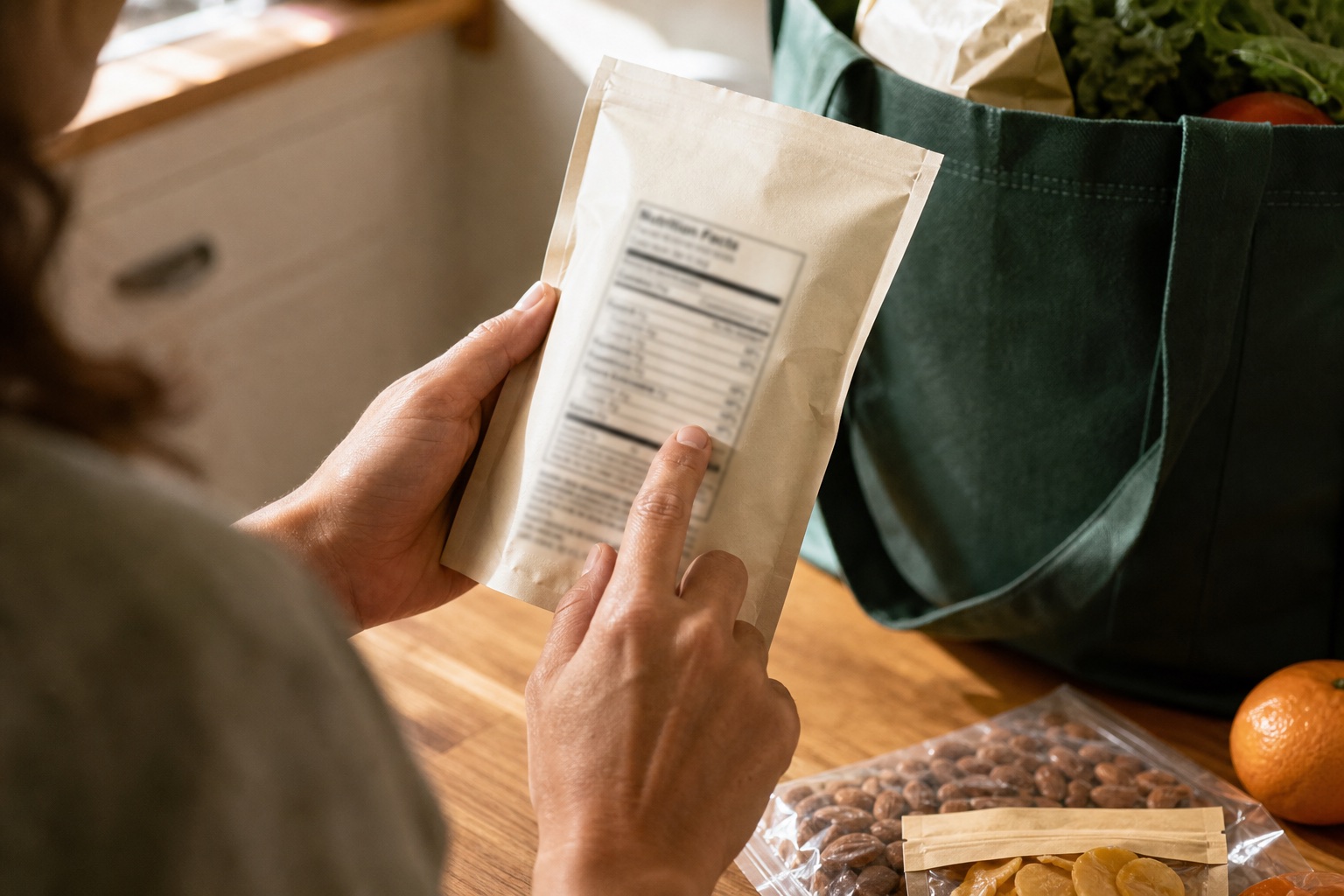
FDA says serving sizes on the Nutrition Facts label reflect the amounts people actually eat, not the amount they should eat. That matters here because a spoonful of powder and a handful of pieces may represent very different labeled servings even when they came from the same fruit.
The ingredient list matters just as much. FDA requires ingredients to be listed in descending order by weight, so the back panel quickly tells you whether you are buying plain fruit or a more formulated product. The powder review above also notes that manufacturers often use carriers such as maltodextrin, gum arabic, or proteins to improve flow, reduce caking, or stabilize the powder. That does not automatically make a powder worse. It does mean you should not assume every fruit powder is equivalent to a bag of fruit pieces that lists one ingredient.
FDA's added-sugars guidance is another useful check. Some powders are simply milled fruit. Others are sweetened blends or flavored mixes. If you care about keeping the product fruit-only, compare the ingredient list, the Added Sugars line, and the fiber on the specific package rather than relying on the product name.
Do not ask whether powder is better than pieces in the abstract. Ask whether this specific powder and this specific bag of pieces are both plain fruit, and whether their serving sizes fit how you will actually use them.
Understand texture, humidity, and what happens after opening
The strongest evidence gap between the formats is not about morality or purity. It is about physical behavior. The 2025 powder review describes berry powders as especially prone to hygroscopicity, stickiness, agglomeration, and caking because their sugars and organic acids make them sensitive to moisture. In plain English: powder is excellent when you want it to blend into food, but it is also the format most likely to clump if humidity gets to it.
A 2022 Journal of Food Engineering study on fruit-powder reconstitution found that water activity and surface properties change how quickly fruit powders disperse. At higher moisture exposure, the powder surface can become softer and more resistant to clean reconstitution. That helps explain why one powder stirs easily into yogurt while another turns pasty or lumpy after a humid week in the pantry.
Pieces have their own downside: they are brittle and can fracture during shipping or repeated handling, which is why some powder at the bottom of a bag is normal. But whole pieces are still the easier format for direct snacking because you do not need a spoon, a blender, or a recipe to make them useful. If you are worried about loss of crunch or moisture pickup after opening, use our guides on how long freeze-dried fruit lasts after opening, keeping it crisp, and why fragments and powder build up in mixed bags.
Compare real value, not just the format name
Pieces can look expensive because freeze-dried fruit is light, while powder can look efficient because a small spoonful goes a long way. Neither impression is reliable by itself. The better question is: which format solves the job I actually have at the serving size I will actually use?
If you want a snack you can eat straight from the pouch, powder is usually poor value no matter how concentrated it is. If you want to flavor overnight oats or color frosting without adding water, powder can be the better buy even when the ounce price looks high. Our freeze-dried fruit price-comparison guide explains why unit price only becomes useful after the format, ingredient list, and real use match.
What this means for you: pieces are usually the better consumer format for snacking, travel, and simple toppings. Powder is usually the better format for blending, baking, and concentrated flavor. The “better” choice is practical, not moral.
A 5-point choice guide
- Name the job. Snack, topping, smoothie, yogurt mix-in, baking ingredient, or decoration.
- Read the ingredient list. Confirm whether it is plain fruit or a more formulated powder with carriers, sweeteners, or flavors.
- Check the labeled serving. Compare calories, fiber, and Added Sugars in the amount you will realistically use.
- Think about storage. Powder usually demands drier handling because clumping and caking happen fast once humidity gets in.
- Price the real use. A handful of snackable pieces and a teaspoon of powder are different jobs, so do not force them into the same shelf comparison.
Pieces are for the bite. Powder is for the mix.
If you are still weighing the broader tradeoffs, continue with Freeze-Dried vs. Fresh Fruit for everyday fit and hydration context, or return to our 60-second label-reading guide for a faster shelf scan.
Primary references
- U.S. FDA: Serving Size on the Nutrition Facts Label
- U.S. FDA: Added Sugars on the Nutrition Facts Label
- U.S. FDA: Types of Food Ingredients
- Uwineza A, Zhang X. Application of Freeze-Drying Technology in the Food Industry: A Review. Foods. 2026;15(4):790. https://doi.org/10.3390/foods15040790.
- Preciado Ocampo V, Yepes Hernandez AL, Marratte R, et al. Effect of Drying Methods on the Physical and Surface Properties of Blueberry and Strawberry Fruit Powders: A Review. Applied Sciences. 2025;15(24):13094. https://doi.org/10.3390/app152413094.
- Gaudel N, Gaiani C, Harshe YM, et al. Reconstitution of fruit powders: A process-structure-function approach. Journal of Food Engineering. 2022;315:110800. https://doi.org/10.1016/j.jfoodeng.2021.110800.