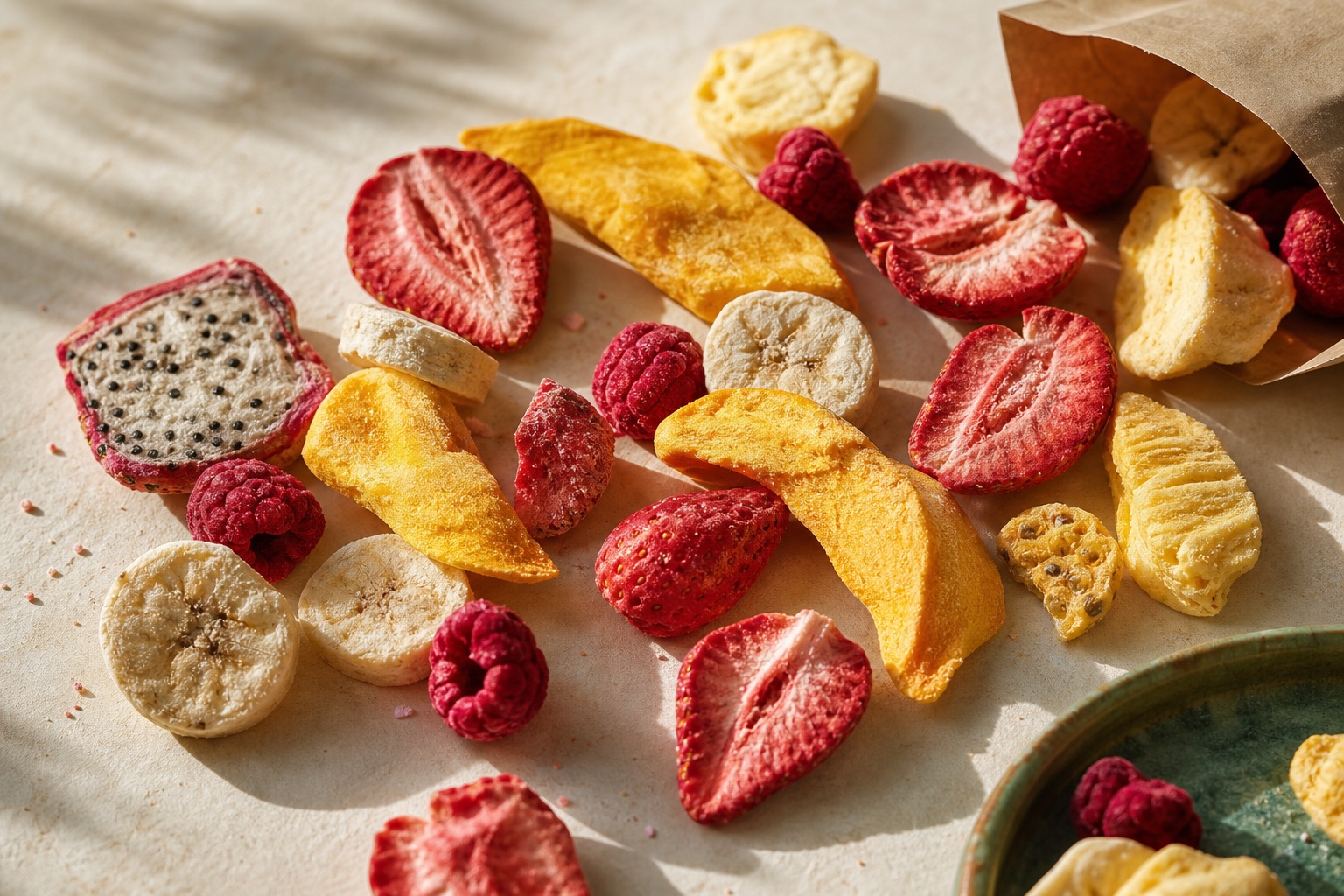
A mixed freeze-dried fruit bag looks simple: select several fruits, dry them, and combine them. In practice, each fruit enters with its own sugars, acids, cell structure, shape, density, brittleness, particle size, and residual water activity. Once sealed together, they become a small physical system.
A mix is a system, not a list
The ingredient list can tell you what is present. It cannot tell you whether one fruit dominates the handful, whether delicate pieces survive distribution, or whether all components remain crisp together. Those questions depend on formulation and process, not just sourcing attractive fruit.
Five variables matter especially:
- the strength and porosity of each fruit;
- water activity and moisture protection;
- piece size, shape, and density;
- flavor intensity and sequence;
- the journey through filling, shipping, shelves, and repeated opening.
Different fruits break differently
A banana slice, strawberry half, apple cube, and raspberry do not share the same architecture. One may be dense enough to act like a small hammer during transport while another fractures under a fingertip. Vibration and drops allow hard or heavy pieces to collide with delicate ones, creating fragments and powder.
“More whole pieces” sounds like an obvious quality goal, but the right cut must also be pleasant to bite, dry evenly, fit through production equipment, and distribute across servings. Large pieces can look generous while making the mix inconsistent. Tiny pieces distribute more evenly but create more exposed surface and may read as crumbs.
Some powder is normal in a brittle food. The more useful question is whether the bag still delivers the promised experience. A mix designed for eating by hand should not arrive mostly as dust; a mix intended as a topping may tolerate smaller pieces.
Moisture can move inside a sealed bag
Sealing the pouch stops neither physics nor time. If two food components have different water activities, moisture tends to move toward equilibrium. Food-science literature uses the classic example of raisins packaged with bran flakes: water moves from the higher-water-activity raisins to the lower-water-activity flakes, making one harder and the other soggier.
Freeze-dried fruits in a well-controlled mix should all be low-moisture, but “low” is not one identical number. Differences in fruit, process, pretreatment, storage, and exposure before sealing can matter. This is one reason a mix cannot be judged solely by testing each component in isolation.
The pouch also needs a strong barrier to outside humidity. Every opening replaces some dry headspace with room air. If the zipper traps fruit dust or does not close fully, all components can soften. Read our storage guide for the practical response.
The fruit is what you eat. The package barrier, seal, headspace, and fill process help determine the fruit you experience.
Size and density decide what reaches your hand
Particles can segregate during movement. Small pieces fall into gaps; large or differently shaped pieces can rise or cluster. Powder collects at the bottom. A bag that began uniformly mixed may not pour uniformly after a truck ride, shelf handling, and several snacks.
This creates a formulation dilemma. A dramatic range of shapes looks abundant and natural, but similar-size pieces may distribute more predictably. Brands can manage the tradeoff through cut specifications, fill sequence, gentle handling, package geometry, and quality-control sampling. No single lever eliminates it.
Consumers can help by gently turning a sealed bag once or twice before opening—not crushing or aggressively shaking it. Even then, every handful will not be mathematically identical, nor does it need to be.
Flavor balance is not the same as equal weight
A tart berry can dominate a mild apple even when it is the smaller component. Aromatic fruit may lead the first impression; sweeter, denser fruit may linger. Acidity, sugar, aroma, piece surface area, and how quickly a piece dissolves all influence perception.
An equal-weight recipe can therefore taste unbalanced, while a sensory-balanced recipe may look unequal on paper. Good formulation asks what happens over the whole bag: Is every handful recognizable? Does one fruit fatigue the palate? Does the mix still taste intentional after the most fragile component has partially broken?
Consistency also has limits. Fruit is agricultural. Variety, ripeness, season, and growing conditions can shift color, sweetness, and acidity. A credible product defines an acceptable range rather than pretending natural ingredients never vary.
How to judge a mixed fruit bag
- Read the ingredient order. Ingredients are listed by weight, which gives context about the mix before you open it.
- Look through a window only as a sample. What faces the window may not represent the full bag.
- Notice distribution over time. Does the last third still feel like the same product as the first?
- Separate breakage from deception. Some fragments are physical reality; a bag routinely dominated by fines is a product-design issue.
- Evaluate the seal. Crispness that disappears after opening may reflect storage behavior, package usability, or both.
- Ask whether the mix earns its complexity. Does the combination create contrast or convenience you value, or would a single fruit serve you better?
A good mix is not merely several ingredients coexisting. It is several ingredients still working together when you reach the bottom of the bag.
To compare the broader category, start with Freeze-Dried Fruit, Decoded. If the label is your main question, use our 60-second scan.
Primary references
- International Journal of Environmental Research and Public Health: Water activity and moisture migration in multicomponent foods
- Foods: Packaging and shelf life of cereals, confectionery, and snacks
- Journal of Food Science and Technology: Water activity and crispness
- U.S. FDA: Ingredient lists and food ingredients