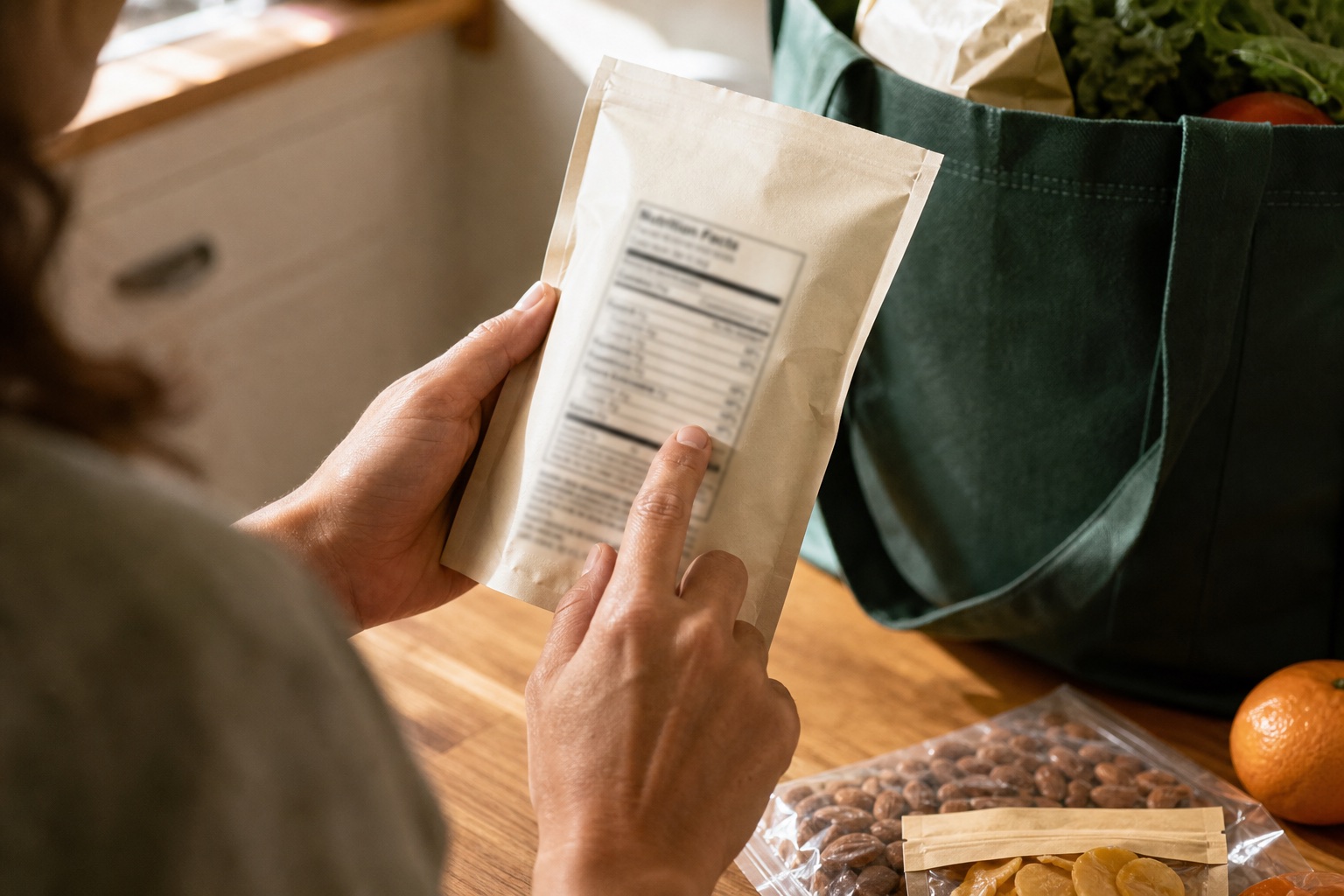
You do not need to audit every nutrient before buying a snack. Start with what you need the snack to do, then use the label to answer a handful of practical questions. This order keeps a single eye-catching number from making the whole decision.
1. Start with portion reality
Serving size anchors every number below it. Compare the listed amount with how much you are likely to eat. A small bag may contain more than one serving; a product that looks calorie-dense per 100 grams may have a very light real-world serving.
The serving size is not a recommendation of how much you personally should eat. It is the reference amount used for the rest of the panel.
FDA's serving-size guidance explains how to scale the panel to your portion. For a made-up snack with two servings per bag and 120 calories per serving, eating the whole bag means 240 calories. If each serving lists 3 grams of fiber, the bag provides 6 grams. These are illustrative numbers, not a tested product or a suggested portion.
Some labels have two columns: one for a serving and one for the package. Read the column heading before doing any multiplication; the whole-package column already includes all its servings. For comparisons between similar snacks, check that you are comparing the same amount of food.
If price is the question, do not stop here: pair serving size with unit price using our freeze-dried fruit price-comparison guide.
For the wider decision, our freeze-dried fruit field guide puts the panel alongside format, texture, and everyday use.
2. Name the snack's job
Are you looking for quick energy, something that carries you to dinner, a crunchy pleasure, or a convenient add-on to another food? The answer changes what matters. A fruit snack and a bean-based snack do not need identical nutrition profiles to be useful.
3. Put sugar in context
Read Total Sugars and Added Sugars as two related but different lines. Total Sugars includes sugars naturally present in foods such as fruit and milk. Added Sugars identifies sugars added during processing. “No added sugar” does not mean “sugar-free,” and it does not need to.
For the exact claims, sweetener names, and examples, use our guide to added sugar in freeze-dried fruit.
4. Check staying power
Fiber and protein can make a snack more substantial. If the snack you want is low in both, that is useful information—not an automatic reason to reject it. You can pair crackers with hummus, fruit with yogurt, or a crisp fruit snack with nuts.
Our 12 better snack pairings includes nut-free, dairy-free, and shelf-stable directions.
5. Scan sodium
The % Daily Value (%DV) helps put sodium into a daily context. The FDA’s general guide describes 5%DV or less per serving as low and 20%DV or more as high. Use that as context rather than a universal pass/fail rule, especially if you have clinician-directed needs.
6. Finish with the ingredient list
Ingredients appear in descending order by weight. Look for the ingredient the package leads with: does the list support the story on the front? Notice sweeteners, oils, seasonings, colors, and allergens that matter to you. Do not use ingredient count alone as a quality score; some good recipes simply contain more components.
Serving size → snack's job → Total/Added Sugars → fiber and protein → sodium → ingredients.
What this means for you: choose the amount you expect to eat, find the matching label column, and compare the nutrients that matter for this snack's job. There is no need to turn the whole panel into a score.
Updated September 24, 2026: added a worked portion example and guidance for two-column labels.
If you have a medical condition, food allergy, or prescribed nutrition target, your personal instructions outrank a general guide. The label is a tool; the useful question is always “useful for whom, and for what?”