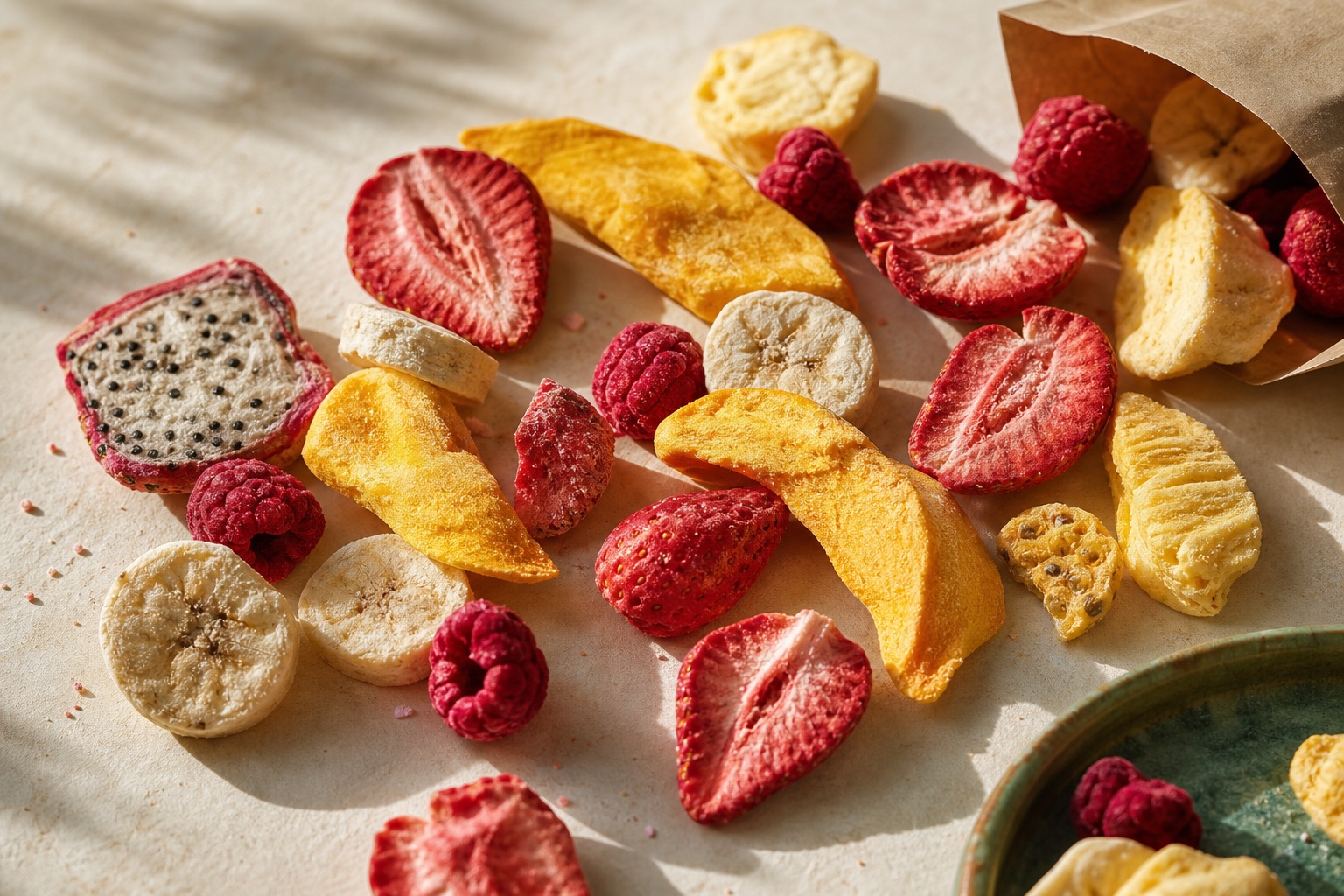
Freeze-dried fruit usually goes soft because it has absorbed moisture—not because the freeze-drying somehow “wore off.” Once the bag is open, humid room air can enter. The fruit’s dry, porous structure gives that moisture plenty of places to go, and its brittle crunch begins to soften.
Why the crunch disappears
Food scientists use water activity to describe how available water is for physical, chemical, and microbial processes. It is related to, but not identical with, total moisture content. A crisp food and the surrounding air move toward equilibrium: when the air is more humid than the food, the food can absorb water.
In many crisp foods, absorbed water acts like a plasticizer. The structure shifts from glassy and brittle toward softer and more rubbery. You experience that physical change as lost snap. Research on low-moisture snacks and packaging consistently identifies water uptake as a central cause of softening.
This also explains why a few minutes in an open bowl on a dry winter day may be uneventful while the same bowl can soften quickly near a steaming dishwasher in summer. Temperature, relative humidity, exposure time, package barrier, and the fruit itself all matter. There is no honest universal “open for exactly X hours” rule.
For the research behind this change, read why crisp foods soften: what water activity and glass transition mean, and why hardness is not the same as crunch.
How to store freeze-dried fruit
- Keep the unopened package sealed. A moisture-proof, intact seal is part of what makes the commercial product shelf-stable.
- Choose a cool, dry place. A pantry away from the stove, dishwasher, kettle, sink, and direct sun is better than a warm, steamy counter.
- Close the package immediately. Do not leave the zipper open while you snack. Remove what you want and reseal.
- Check the zipper track. Fruit powder can keep a press-to-close seal from mating properly. Brush the track clean and run your fingers across its full width.
- Use a tight container when needed. If the original package no longer seals, transfer the fruit to a clean, dry, airtight container sized reasonably close to the amount left.
- Follow the manufacturer’s label. Product-specific storage directions and best-by information outrank general advice.
Humid air, a poor seal, and time exposed. Heat and light can also accelerate other quality changes.
A better routine after opening
Pour the portion you plan to eat into a dry bowl instead of repeatedly reaching into the bag. Wet hands, a damp measuring cup, or a spoon that has touched yogurt can carry moisture directly into the package. Avoid eating over a pot or mug that is producing steam.
If you are packing some for later, use a dry container with a reliable closure. A loose sandwich bag may keep pieces together, but it is not always a strong moisture barrier. For a short outing that may be fine; for longer storage, use the original high-barrier package or a suitable airtight container.
Need a more specific packing routine for commutes, school lunches, road trips, or flights? Use our travel-and-lunchbox guide for the dry-versus-perishable checklist.
Do not remove or eat any packet included for moisture or oxygen control. Keep it away from children and follow the package warning. Its presence does not replace closing the bag.
What if it already turned soft?
Slight softening is first a texture problem. The fruit may still work well stirred into oatmeal, blended into a smoothie, folded into batter, or crushed into a topping where perfect crunch is not the goal. Our freeze-dried-fruit uses guide walks through those jobs in more detail.
We do not recommend a universal home “re-crisping” method. Ovens and dehydrators vary, fruit sugars can scorch, and heating cannot reverse contamination or make a compromised product safe. If you try a manufacturer-provided method, follow its instructions exactly and use the fruit promptly.
Quality loss is not the same as a safety verdict
A softer bite alone does not diagnose spoilage, but a visibly damaged package, broken seal, unexpected moisture, condensation, mold, insects, or an off odor are reasons not to eat the product. When in doubt, discard it or contact the manufacturer with the lot information.
Freeze-drying reduces water activity; it is not a sterilization promise. Dried foods can still be involved in recalls, and moisture introduced after processing can change their stability. Check FDA recall notices if you have a product-specific concern.
For a complete discard checklist, read Can Freeze-Dried Fruit Go Bad?. If the fruit still looks and smells normal and your question is simply how long to keep the open bag, use our after-opening guide.
What to look for before you buy
A package does real technical work. Look for an intact seal, no punctures, and a closure you can realistically use. If you tend to snack slowly, several smaller sealed packs may protect texture better than one large bag opened many times, though they use more packaging.
For a closer look at moisture barriers, oxygen absorbers, and the limits of judging a bag by appearance, read what a freeze-dried fruit pouch has to do.
Powder at the bottom can result from normal breakage and shipping; it is not by itself evidence of moisture damage. Large pieces, delicate berries, and mixed-fruit bags can break at different rates. For the mechanics behind that, read Why Mixed Fruit Bags Are Hard to Get Right.
New to the category? Start with our freeze-dried fruit field guide.
For crisp food, the package is not decoration. It is part of the product.