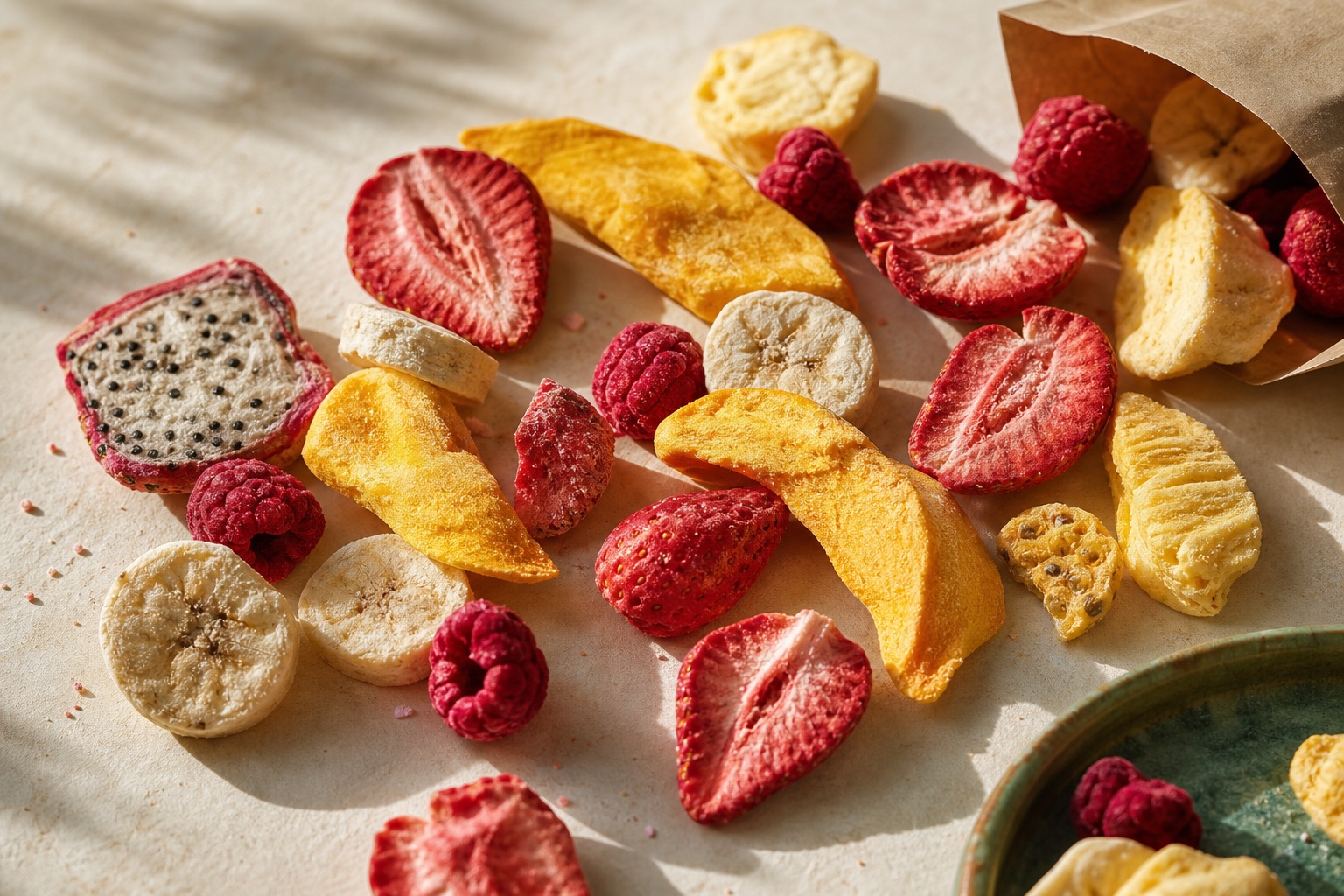
Freeze-dried fruit does not have one universal after-opening shelf life. A well-sealed commercial product kept dry may hold its quality far longer than a bag left open in a humid kitchen. The manufacturer's directions and date are the best product-specific starting point.
The first noticeable change is often loss of crunch, not a dramatic moment when the fruit suddenly becomes unusable. That is why a promise such as “always good for 30 days after opening” would be misleading without knowing the fruit, residual water activity, packaging, handling, and storage environment.
What actually starts the quality clock?
Commercial freeze-drying removes water by sublimation under vacuum. USDA describes properly freeze-dried foods as shelf-stable when they are protected by moisture-proof, hermetically sealed packaging. Opening that package changes the system: room air enters, and the fruit can begin absorbing water from it.
Five variables shape what happens next:
- Relative humidity. A dry room and a steamy kitchen do not create the same exposure.
- Time open. Repeated short openings accumulate; one long open-bowl session can matter even more.
- Seal quality. A zipper blocked by fruit dust may look closed while leaving a path for air.
- Package barrier. The original pouch may control moisture better than a thin household bag.
- The fruit and process. Shape, porosity, sugars, piece size, drying endpoint, and handling differ.
Water activity describes how available water is for physical, chemical, and microbial processes. It is not the same as total water content. As a dry, crisp food takes up moisture, its brittle structure can become softer. See what food science says about humidity and texture for the evidence, and our storage guide for the everyday routine.
The two-minute after-opening routine
- Read the package first. Follow any “refrigerate after opening,” “consume within,” or other product-specific instruction.
- Pour out only what you want. A dry bowl keeps hands and utensils from repeatedly entering the package.
- Clear the zipper. Brush away powder and small fragments from the closing track.
- Press out excess air gently. Do not crush delicate pieces to chase every pocket of air.
- Seal the full width. Run your fingers from one end of the zipper to the other and check both corners.
- Return it to a cool, dry, dark place. Keep it away from the stove, sink, dishwasher, kettle, direct sun, and a hot car.
Instead of “How many days has it been?”, ask “Was it kept dry, was the package truly closed, and has anything changed besides texture?”
When should you move it to another container?
Keep the original pouch when its barrier and closure are intact. Move the fruit when the zipper is damaged, the pouch is punctured, or the remaining amount is so small that the package is mostly humid headspace after every opening.
Choose a clean, completely dry, airtight food container sized close to the amount left. A clear container makes condensation or insects easier to see, but store it out of direct light. A loose sandwich bag can organize a snack for a short outing; it should not automatically be treated as equivalent to the original high-barrier package.
For the short-outing version of that question, our travel-and-lunchbox packing guide covers when a simple snack bag is good enough and when structural protection matters more.
Do not eat any packet included for moisture or oxygen control. Leave it intact, follow the package warning, and keep it away from children. The packet is not a substitute for closing the container.
Separate quality loss from a safety decision
A softer texture alone usually tells you that the fruit absorbed moisture. It does not prove the food is spoiled, and it does not prove the food is safe. FDA notes that drying can prevent bacterial growth without necessarily killing organisms such as Salmonella. A dry product therefore should not be described as sterile.
Discard the product rather than taste-testing it when you see mold, condensation, unexpected wet patches, insects or webbing, a damaged seal, or a distinctly off odor. Check current FDA recalls for a product-specific concern. Our companion guide, Can Freeze-Dried Fruit Go Bad?, provides the full decision checklist.
Common after-opening questions
Should opened freeze-dried fruit go in the refrigerator?
Not unless the product label says so. Refrigerators contain moisture, and condensation can form when a cold container is opened in warmer air. For products labeled shelf-stable, a cool and dry pantry with a strong seal is generally the more relevant condition.
Can I keep eating it when it is soft?
If softening is the only change and the product was handled correctly, it may still be useful in oatmeal, smoothies, baking, or as a crushed topping. Do not use texture as the only safety test.
Does the best-by date reset when I open the bag?
No. A best-by date is generally about expected quality under the manufacturer's defined conditions; opening changes those conditions. It is not a new countdown printed specifically for your kitchen.
The calendar matters. Moisture history matters more.
For category fundamentals, start with Freeze-Dried Fruit, Decoded. For mixed bags, where different pieces also collide and settle, see Why Mixed Fruit Bags Are Hard to Get Right.