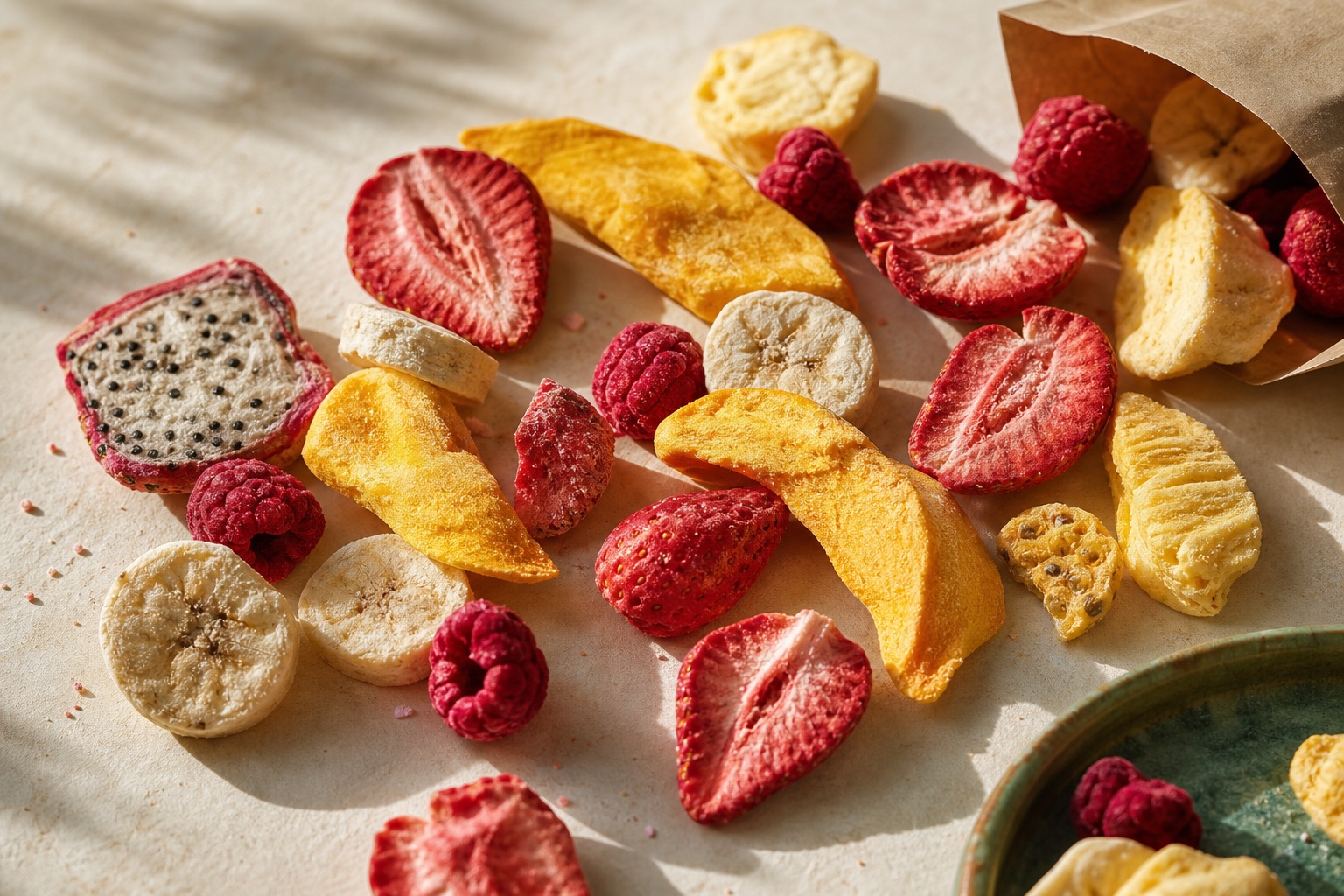
Freeze-dried fruit works best when you match the format to the job. Keep pieces dry until the last minute when you want crunch. Let them soften on purpose in wetter foods when you want chew or visible fruit. Use powder when you want color, aroma, or fruit flavor to disappear into a recipe without adding much liquid.
That framework comes straight from the food science. Reviews of freeze-drying describe fruit as light, porous, and quick to rehydrate, while fruit-powder reviews describe powders as especially useful in beverages, yogurts, cereals, bakery products, and other formulated foods. The better question is not "What else can I do with this bag?" It is "Do I want crunch, softness, or a smooth blend?"
Start with moisture, not inspiration
A 2026 review by Angelique Uwineza and Xiaojun Zhang in Foods explains why freeze-dried fruit behaves differently from fresh or chewy dried fruit: the process removes water while preserving a highly porous structure. A 2024 texture review by Shuyi Feng and co-authors in Trends in Food Science & Technology describes that structure as a dry scaffold whose texture depends heavily on final water content.
That is the practical key. If you want the fruit to stay crisp, keep it away from moisture until serving. If you want it to soften, give it liquid and time on purpose instead of by accident. If you want fruit flavor without pieces, use powder. FDA's guidance on water activity helps explain why: dry foods move toward equilibrium with the surrounding moisture, and that shift changes texture and stability.
Powder needs one more caution. The 2025 Applied Sciences review by Valentina Preciado Ocampo and colleagues notes that berry powders are especially prone to hygroscopicity, stickiness, agglomeration, and caking. In plain English, powder is excellent when you want it to blend in, but it is the format most likely to clump if humidity gets in.
If the goal is crunch, add freeze-dried fruit last. If the goal is a smooth mix, use powder. If the goal is soft fruit, rehydrate or stir it into something wet on purpose.
15 practical ways to use freeze-dried fruit beyond snacking
1. Yogurt bowls and parfaits
Best format: pieces for crunch, powder for a flavored swirl. Add pieces right before eating so they stay crisp. Stir powder in earlier if you want even color and flavor without extra liquid.
2. Oatmeal and other hot cereals
Powder disappears neatly into hot oats. Pieces work too, but treat them like a topping if you want any crispness left. If they go in early, expect them to soften and behave more like rehydrated fruit.
3. Cold cereal and granola
Freeze-dried fruit fits where milk would quickly flatten fresh crisp toppings. Add it at the table, not while the bowl sits, and keep it separate from milk until the last minute if texture matters.
4. Smoothies and shakes
Best format: powder or finely crushed fruit. This is one of the clearest non-snack uses because you get fruit flavor and color without watering the drink down with fresh fruit or juice.
5. Overnight oats
Use powder when you want the fruit fully integrated by morning. Use pieces when you want visible fruit and are comfortable with a softer bite after the overnight soak.
6. Chia pudding
The same rule applies here: powder for an even flavor base, pieces for a more obvious fruit presence. If you care about visual contrast, hold back some pieces and add them just before serving.
7. Pancake or waffle batter
Best format: powder. Reviews of fruit and vegetable powders in cakes show that powders can change batter behavior because they absorb water and affect texture, volume, and density. In practical terms, powder lets you add fruit character without introducing wet fruit chunks that can throw off the griddle or waffle iron.
8. Muffins, quick breads, and snack cakes
Powder gives the cleanest color and flavor distribution. Small crushed pieces can work when you want pockets of fruit, but start modestly because fruit powders can change how a batter holds water and rises.
9. Frosting, glaze, and whipped toppings
Best format: powder. This is one of the strongest practical arguments for freeze-dried fruit because you can add fruit flavor and color without thinning the mixture the way puree or juice often does.
10. Cottage cheese or ricotta bowls
Pieces bring tart crunch. Powder turns the bowl more dessert-like with less texture contrast. Either way, add freeze-dried fruit after portioning rather than letting it sit in a wet container all day.
11. Ice cream, frozen yogurt, and pudding
Freeze-dried fruit adds an airy crisp contrast that soft desserts usually lack. Sprinkle it on at service, not during storage, or it will lose the texture you wanted it for.
12. Salads and grain bowls
Pieces can act like a tart-sweet accent where fresh fruit might leak juice or make greens soggy. Add them after dressing for the same reason you would wait on croutons.
13. Homemade granola, muesli, or cereal bars
Stir freeze-dried fruit in after baking and cooling if you want to preserve its texture. For no-bake bars, powder usually integrates more evenly than large brittle pieces.
14. Energy bites and oat balls
Best format: powder or crushed fruit. Large pieces can shatter or pull moisture unevenly through a sticky mixture. Powder distributes flavor more predictably.
15. Quick fruit sauces, coulis, or dessert spoonfuls
When you deliberately add liquid, freeze-dried fruit can move from crisp topping to soft fruit ingredient quickly because of its porous structure and strong rehydration behavior. That makes it useful when you want a fast berry-style spoonful for cheesecake, pancakes, or yogurt without starting from fresh fruit.
Choose pieces, powder, crushed fruit, or soft rehydrated fruit
Use pieces when the point is visible fruit and crisp or chewy contrast. Use powder when liquid control matters or you want the fruit to disappear into the mix. Use crushed fruit when you want a middle ground for no-bake mixtures, sprinkled toppings, or quick blending. Use intentionally softened fruit when the recipe benefits from a jammy or rehydrated texture.
Naima Gaudel and co-authors' 2022 Journal of Food Engineering paper found that fruit-powder reconstitution changes with water activity and surface properties. At higher moisture exposure, powders can form a softer, more resistant surface layer that slows clean dispersion. That is why one powder dissolves smoothly while another turns pasty after a humid week in the pantry.
Label details also matter. The 2025 berry-powder review notes that some powders use carriers or stabilizing ingredients to improve flow and reduce caking. If you want fruit-only powder, read the ingredient list instead of assuming every bright pink powder is simply milled berries. Our powder-versus-pieces guide walks through that label check in more detail.
What this means for you
Most of the evidence here comes from food engineering and product-development studies, not from one grand trial of 15 home-kitchen uses. That means the exact amount that works best will still depend on the fruit, particle size, humidity, and recipe. What the evidence does support is the broader decision framework:
- If you want crunch, wait. Add the fruit at the end or pack it separately.
- If you want color and flavor without extra liquid, use powder. This is where freeze-dried fruit often beats fresh fruit.
- If you want soft fruit, wet it on purpose. Overnight oats, chia pudding, and quick sauces can all use that rehydration.
- If you are baking, start modestly. Powders can change how a batter absorbs water and sets.
- If you are storing an opened bag, protect it from humidity. Use our storage guide and after-opening guide if texture retention matters.
The best use follows the water.
If you are new to the category, start with Freeze-Dried Fruit, Decoded. If your real question is how to turn freeze-dried fruit into a more filling snack, go next to 12 better snack pairings.
Primary references
- U.S. FDA: Water Activity (aw) in Foods
- Uwineza A, Zhang X. Application of Freeze-Drying Technology in the Food Industry: A Review. Foods. 2026;15(4):790. https://doi.org/10.3390/foods15040790.
- Feng S, Bi J, Laaksonen T, Lauren P, Yi J. Texture of Freeze-Dried Intact and Restructured Fruits: Formation Mechanisms and Control Technologies. Trends in Food Science & Technology. 2024;143:104267. https://doi.org/10.1016/j.tifs.2023.104267.
- Preciado Ocampo V, Yepes Hernandez AL, Marratte R, et al. Effect of Drying Methods on the Physical and Surface Properties of Blueberry and Strawberry Fruit Powders: A Review. Applied Sciences. 2025;15(24):13094. https://doi.org/10.3390/app152413094.
- Gaudel N, Gaiani C, Harshe YM, et al. Reconstitution of Fruit Powders: A Process-Structure-Function Approach. Journal of Food Engineering. 2022;315:110800. https://doi.org/10.1016/j.jfoodeng.2021.110800.
- Salehi F, Aghajanzadeh S. Effect of Dried Fruits and Vegetables Powder on Cakes Quality: A Review. Trends in Food Science & Technology. 2020;95:162-172. https://doi.org/10.1016/j.tifs.2019.11.011.