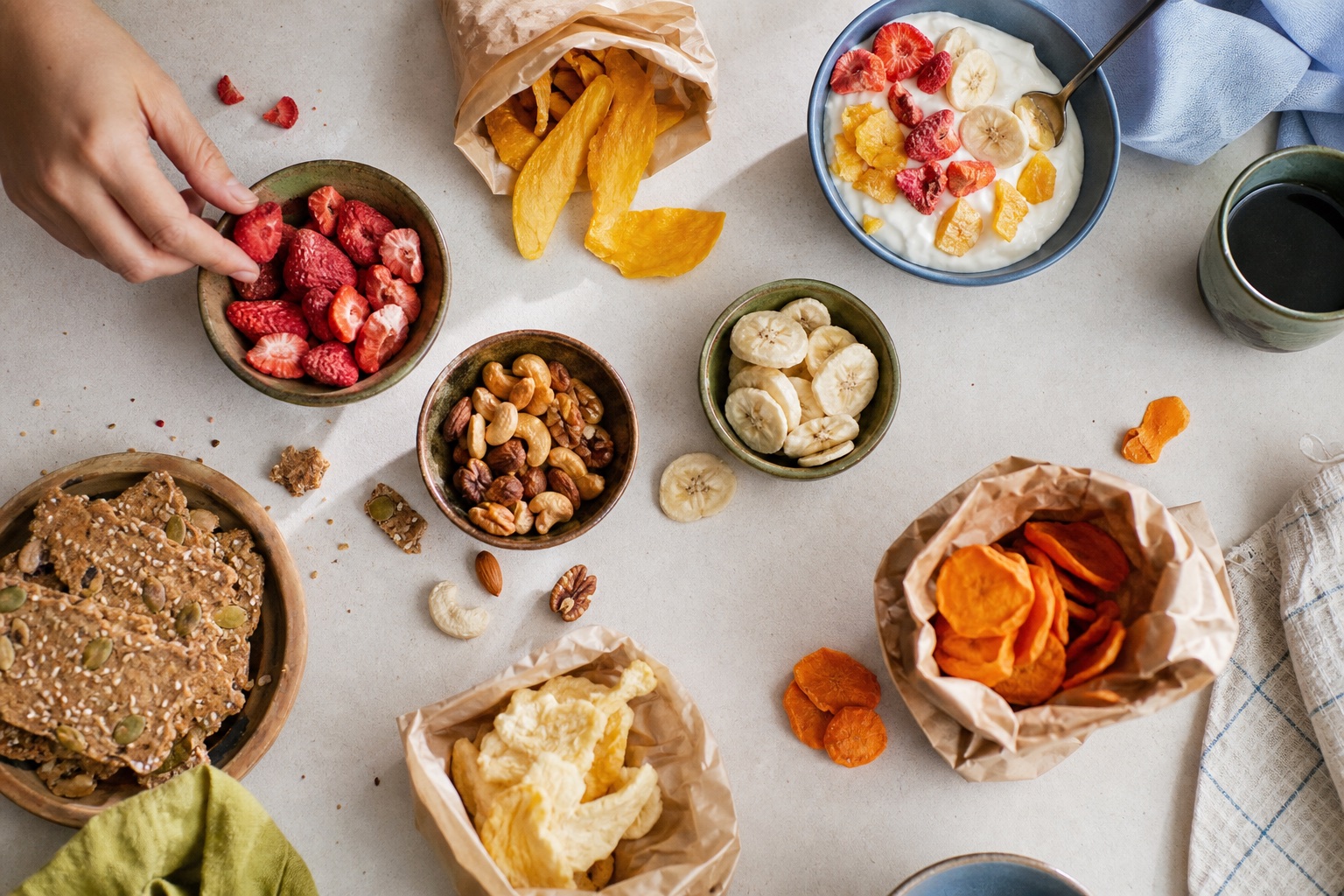
A snack is more than a calorie count, and “healthy” is too broad to be a verdict. The Better Snack Framework is our way of reviewing products consistently while leaving room for different bodies, budgets, routines, tastes, and goals.
Why a framework?
Snack packaging is crowded with claims: natural, clean, high-protein, no sugar added, plant-based, keto-friendly. Some claims are regulated; others are mostly positioning. A repeatable framework helps us look past the loudest words and back at the product itself.
We use the framework when we write category guides, compare product formats, or discuss a specific snack. It is not clinical nutrition advice, and it does not sort foods into morally “good” and “bad” buckets.
Good snacking is a pattern, not a purity test.
The five lenses
1. Ingredients
We start with the ingredient list. What is the snack actually made from? Is the product’s defining ingredient first? Are flavors, oils, sweeteners, colors, or coatings important to the eating experience? A longer list is not automatically worse, and a short list is not automatically complete nutrition.
2. Staying power
Fiber and protein can help a snack feel more substantial, but not every snack needs to be a meal. We look at what the format contributes and suggest pairings when a snack is primarily quick energy or pleasure—for example, fruit with yogurt or nuts.
3. Sugar context
Total sugars and added sugars answer different questions. Fruit and dairy naturally contain sugars; the Nutrition Facts panel separately lists sugars added during processing. We report both when relevant and avoid treating fruit sugar as identical to a sweetener added to a product.
4. Sodium context
Sodium is easy to underestimate in savory snacks and easy to sensationalize in isolation. We compare a realistic serving with the label’s Daily Value and consider how the snack is likely to be eaten.
5. Everyday fit
The best label on paper is not useful if the snack is unaffordable, unpleasant, unavailable, or impractical. We consider portability, texture, portion reality, price visibility, allergen information, and whether the product delivers on the experience it promises.
Why we avoid one score
A single score creates false precision. The snack that works before a run may not be the one that keeps someone full through an afternoon. A child, an endurance athlete, and a person following clinician-directed dietary advice can reasonably prioritize different things.
Plain-language strengths, tradeoffs, label facts, useful pairings, and who a format may suit. When we compare products, we publish the comparison criteria.
How we research
We begin with the current package label and the manufacturer’s product page, then check relevant primary sources such as U.S. Food and Drug Administration labeling guidance and USDA food data. When a piece includes tasting, price checks, or hands-on use, we say so. When it does not, we do not imply that it does.
Corrections matter. Packaging and formulas change, so every guide carries a publication or update date. Readers and brands can send a correction to hello@eatbettersnacks.com.
Commercial disclosure
Eat Better Snacks launched with support from OhCrisp, a freeze-dried snack brand. That relationship is disclosed sitewide. It does not buy a favorable rating, exemption, or undisclosed placement. Product-specific commercial relationships will be labeled on the relevant page.