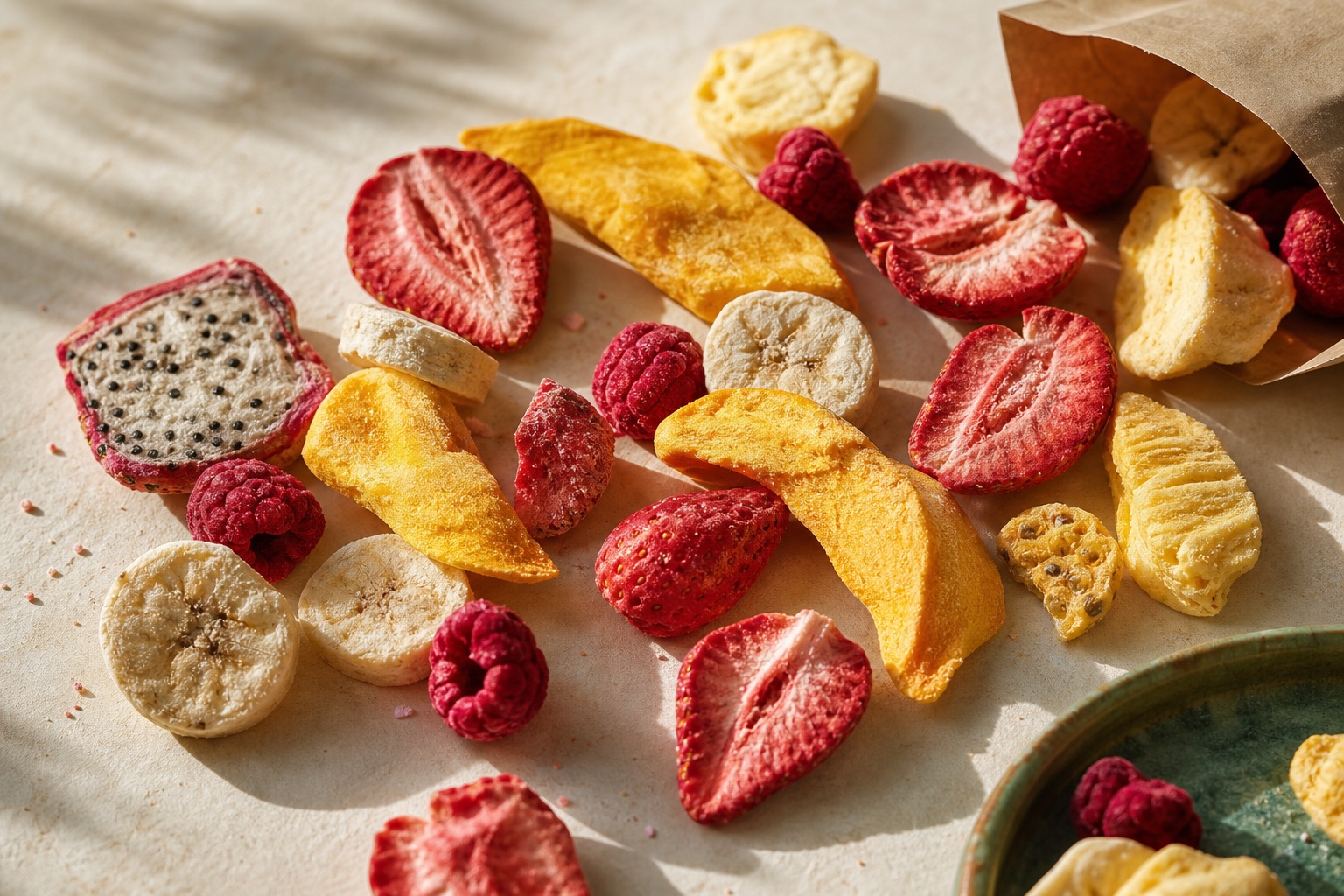
The useful difference is simple: freeze-dried fruit is usually airy and crisp; conventionally dried fruit is usually dense and chewy. Neither description tells you whether sugar was added, whether the portion fits your needs, or whether you will enjoy it. For those answers, you still need the package.
The short answer
Choose freeze-dried fruit when you want crunch, very low carrying weight, or a fruit that can be crushed into a powder. Choose conventional dried fruit when you want chew, a compact source of energy, or something that holds up well in a bag. If your priority is a short ingredient list, either format can qualify—but neither is guaranteed to.
Crunch and lightness: freeze-dried. Chew and compactness: heat-dried. For added sugar, allergens, and serving size: read the label on the product in your hand.
How each is made
Freeze-dried fruit
The fruit is frozen and placed under vacuum. Under those conditions, much of the ice leaves as vapor without first becoming liquid—a process called sublimation. The spaces that held ice remain as pores, giving the finished fruit its low density and brittle crunch. The USDA describes commercial freeze-drying as a preservation process that can produce shelf-stable food when the finished product is protected in moisture-proof, hermetically sealed packaging.
Conventionally dried fruit
Many familiar dried fruits are made by moving warm air over the fruit so liquid water evaporates. Time, temperature, airflow, pretreatments, fruit variety, and cut size all shape the result. Removing water this way usually creates a denser, pliable texture. Sun-drying, oven-drying, vacuum drying, and hybrid processes can produce still other results, so “dried” is a family of methods rather than one recipe.
Research comparing methods does not produce one universal nutrient winner. Outcomes vary by fruit, compound, temperature, and process. Studies on mulberries and kiwifruit found that freeze-drying better retained several heat-sensitive compounds than hot-air drying, while other fruit studies have reported different rankings for particular nutrients. That is why we avoid claims that freeze-drying “locks in all nutrients.”
Texture, flavor, and the crumbs question
Freeze-dried pieces fracture easily because of their porous structure. That creates a clean crunch—and more potential for breakage and powder during shipping. Conventional dried fruit bends and compresses instead, so it tends to travel with fewer crumbs.
Removing water changes flavor perception in both formats. Freeze-dried fruit can taste bright and quickly dissolve on the tongue. Heat-dried fruit often tastes deeper, sweeter, or more caramel-like, depending on the fruit and temperature. These are sensory differences, not evidence that one product contains added sugar.
Nutrition and portions: compare what you eat
Water makes fresh fruit heavy. Once much of it is removed, fruit sugars, fiber, and calories become more concentrated by weight. Comparing 100 grams of dried fruit with 100 grams of fresh fruit therefore answers a laboratory-style question, not necessarily a snack question.
Start with the labeled serving and the amount you will actually eat. Freeze-dried pieces occupy a lot of space but weigh little; chewy dried fruit packs more tightly. USDA MyPlate materials use ½ cup dried fruit as one cup-equivalent of fruit, a reminder that dried portions are not visually interchangeable with fresh ones. The Nutrition Facts panel on your bag remains the better guide for that specific product.
If hydration matters—after exercise, in hot weather, or simply because you have not had much to drink—neither dried format replaces the water in fresh fruit. Bring a drink or choose a water-rich food alongside it.
Ingredients to check
- Fruit: Is the named fruit first, and is it the only ingredient?
- Added sweeteners: Check both the ingredient list and the Added Sugars line. Total Sugars alone cannot tell you what was added.
- Oil: Some dried fruits use oil to reduce sticking. That may be functional rather than a red flag.
- Preservatives or color treatments: Decide whether these matter to you; do not infer their presence from the drying method.
- Coatings and allergens: Yogurt-style, chocolate, seasoning, or shared-equipment statements may change the product substantially.
For a deeper label walkthrough, use our 60-second snack-label scan and our guide to added sugar in freeze-dried fruit.
Which should you choose?
For a desk drawer: either, provided the package reseals. Freeze-dried fruit needs especially good protection from humidity.
For a hiking bag: chewy dried fruit is compact and less breakable; freeze-dried fruit is lighter and offers crunch. Your space and texture preference decide.
For yogurt or oatmeal: chewy fruit tolerates moisture; freeze-dried fruit should go on at the last moment if you want it crisp.
For baking and decorating: freeze-dried fruit powder adds color and concentrated flavor without much liquid. Chewy dried fruit adds pockets of texture. If you are deciding between a spoonable powder and a snackable whole-piece bag, use our freeze-dried fruit powder-versus-pieces guide.
For a child or anyone with chewing or swallowing concerns: texture and piece size matter. Follow age-appropriate guidance and individual care instructions; dry, brittle foods are not right for every eater.
The better format is the one whose texture, label, portion, and purpose line up with the moment.