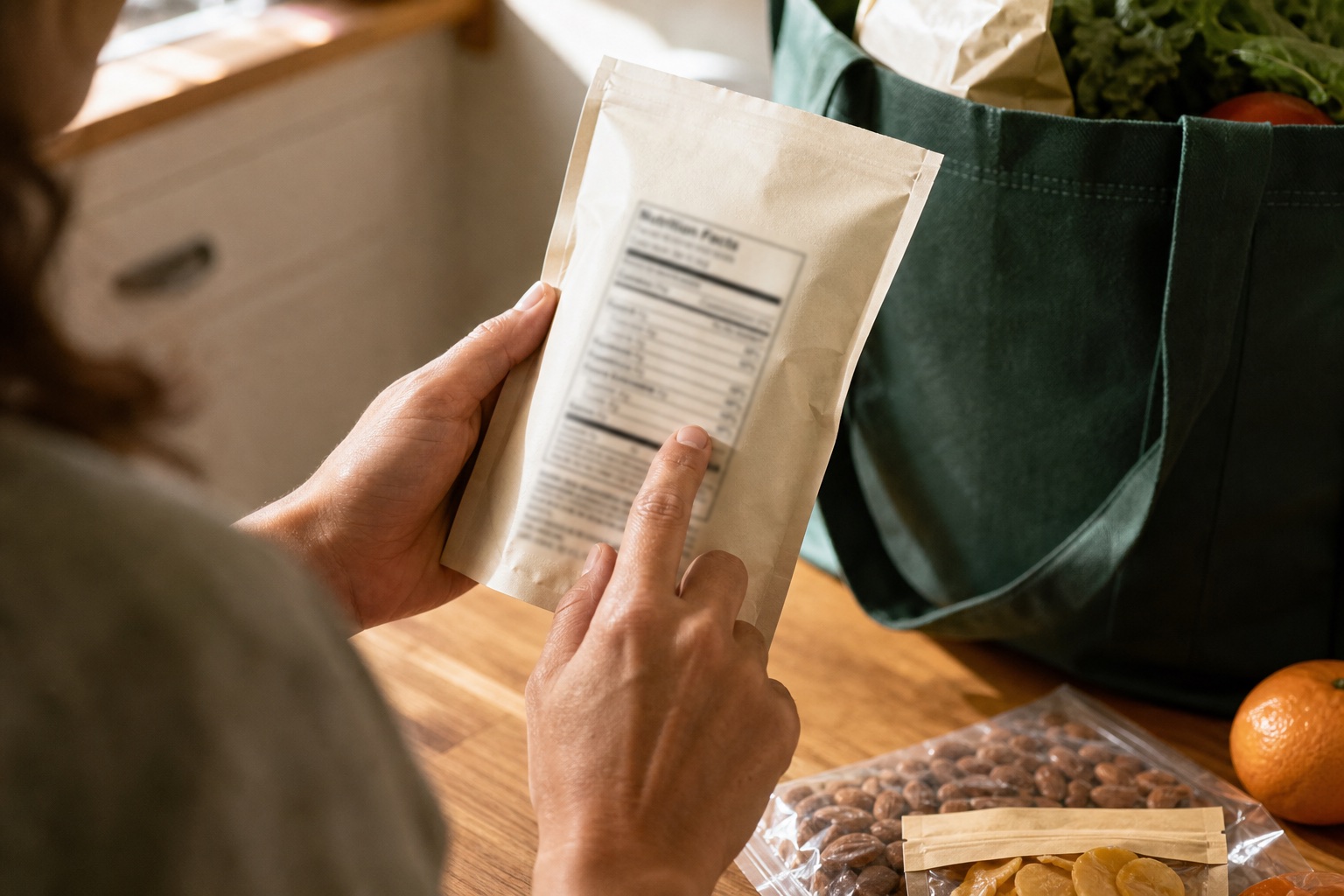
To compare freeze-dried fruit prices well, start with the shelf tag's unit price only after you have matched the fruit, ingredient list, and package type. Then translate that number into price per labeled serving. If you jump between fresh, frozen, conventionally dried, and freeze-dried products, stop using price per ounce alone: water content and edible yield change the meaning of the weight.
This is why one tiny pouch can look shockingly expensive while still being the better comparison inside its own category. The useful goal is not to prove that freeze-dried fruit is always a bargain. It is to avoid bad arithmetic.
Start with unit price, but only within a real like-for-like match
NIST Handbook 130 includes a Uniform Unit Pricing Regulation because unit price is one of the fastest ways to compare packaged foods on a shelf. When the tag is missing, do the same math yourself: divide the shelf price by the net weight in ounces or grams.
But unit price only works when the products are truly comparable. A plain freeze-dried strawberry bag is not the same proposition as a fruit-and-yogurt blend, a sweetened fruit snack, or a mixed-fruit pouch with very different piece sizes. Front-of-pack marketing can blur those differences, so compare the ingredient list and Nutrition Facts panel before you compare the number on the shelf.
Match these before you compare:
- The fruit itself. Strawberries against strawberries, not strawberries against bananas.
- The ingredient story. Fruit-only against fruit-only, not plain fruit against sweetened or coated products.
- The use case. Snackable pieces, smoothie powder, and topping crumbs can all be edible without being equal values for the same job. Our powder-versus-pieces guide separates those tradeoffs.
If the ingredient list is doing part of the pricing story, our 60-second label guide and added-sugar explainer are the faster follow-ups than guessing from the front panel.
Check price per serving, not just price per ounce
FDA says serving sizes on the Nutrition Facts label reflect the amounts people actually eat, not the amount they should eat. That matters because freeze-dried fruit is very light: two bags can have similar price-per-ounce math yet very different labeled serving sizes.
Once you have the unit price, do one more calculation:
- Find the grams or ounces per labeled serving.
- Multiply that by the unit price.
- Check how many servings the package contains.
That second view is often more realistic for breakfast toppings, lunchboxes, and snack breaks. FDA's label format can also show per-package or dual-column information on some packages that are likely to be eaten in one sitting. When the bag is effectively one occasion, price per package may matter more than a neat per-ounce number.
Unit price tells you what the product costs by weight. Price per serving tells you what the product costs in the way the package expects to be used.
Do not compare fresh, frozen, dried, and freeze-dried fruit by ounce alone
USDA's Economic Research Service documents fruit prices not only per pound as purchased, but also per edible cup equivalent. That is a clue about the comparison problem: water, peels, pits, and concentration change what a pound means in practice.
Freeze-dried fruit is deliberately dry and lightweight. Reviews of freeze-drying describe a porous structure created as ice sublimes under low pressure, which helps explain the crisp texture and small final weight. The same one-ounce measurement therefore does very different work in a fresh berry clamshell and in a freeze-dried pouch.
When you compare across formats, ask a different question: which product delivers the amount of fruit and the eating experience I actually want for this job? If the answer is hydration or a large-feeling bowl, fresh fruit may be the better buy. If the answer is portability, low mess, pantry backup, or crunch, the freeze-dried option may still be the better value even when the ounce price is higher. Our fresh-versus-freeze-dried guide separates those tradeoffs in plain English.
Check usable form, breakage, and package quality
The physical form matters. A bag full of intact pieces is different from a bag full of powder if your plan is to snack straight from the pouch. If your plan is yogurt, oatmeal, or baking, the powder may be perfectly useful. Price only makes sense after you define the job.
Research reviews on freeze-dried foods describe the same porous structure that creates crunch as a source of fragility. That means breakage during shipping and repeated opening is not a trivial detail; it can change how much of the bag still fits the use you paid for.
The package matters too. A product that softens before you finish it can become worse value than a smaller bag with a better barrier and closure. If storage is part of the decision, read how long freeze-dried fruit lasts after opening and how to keep it crisp.
A 5-step checklist for the aisle
- Match the fruit. Compare the same fruit before comparing the price.
- Match the ingredients. Plain fruit, sweetened fruit, powders, and blends belong in different buckets.
- Use unit price. Compare cost per ounce or gram only after steps one and two match.
- Convert to price per serving. The label tells you whether the cheap-looking bag is still expensive in the way you actually eat it.
- Check the usable outcome. Pieces, crumbs, package barrier, and whether you will finish the bag all affect real value.
What this means for you: the best price is usually not the cheapest bag in the aisle. It is the cheapest bag that solves the same problem, with the same kind of fruit, in the same realistic portion.
Good price comparisons start after you stop pretending that every light fruit pouch is the same product.
For the broader category mechanics behind the price, continue with Why Freeze-Dried Fruit Is So Expensive. If you want the bigger picture before comparing any format, start at Freeze-Dried Fruit, Decoded.
Primary references
- NIST Handbook 130: Uniform Unit Pricing Regulation
- U.S. FDA: Serving Size on the Nutrition Facts Label
- U.S. FDA: How to Understand and Use the Nutrition Facts Label
- USDA ERS: Fruit and Vegetable Prices documentation
- Uwineza A, Zhang X. Application of Freeze-Drying Technology in the Food Industry: A Review. Foods. 2026;15(4):790.