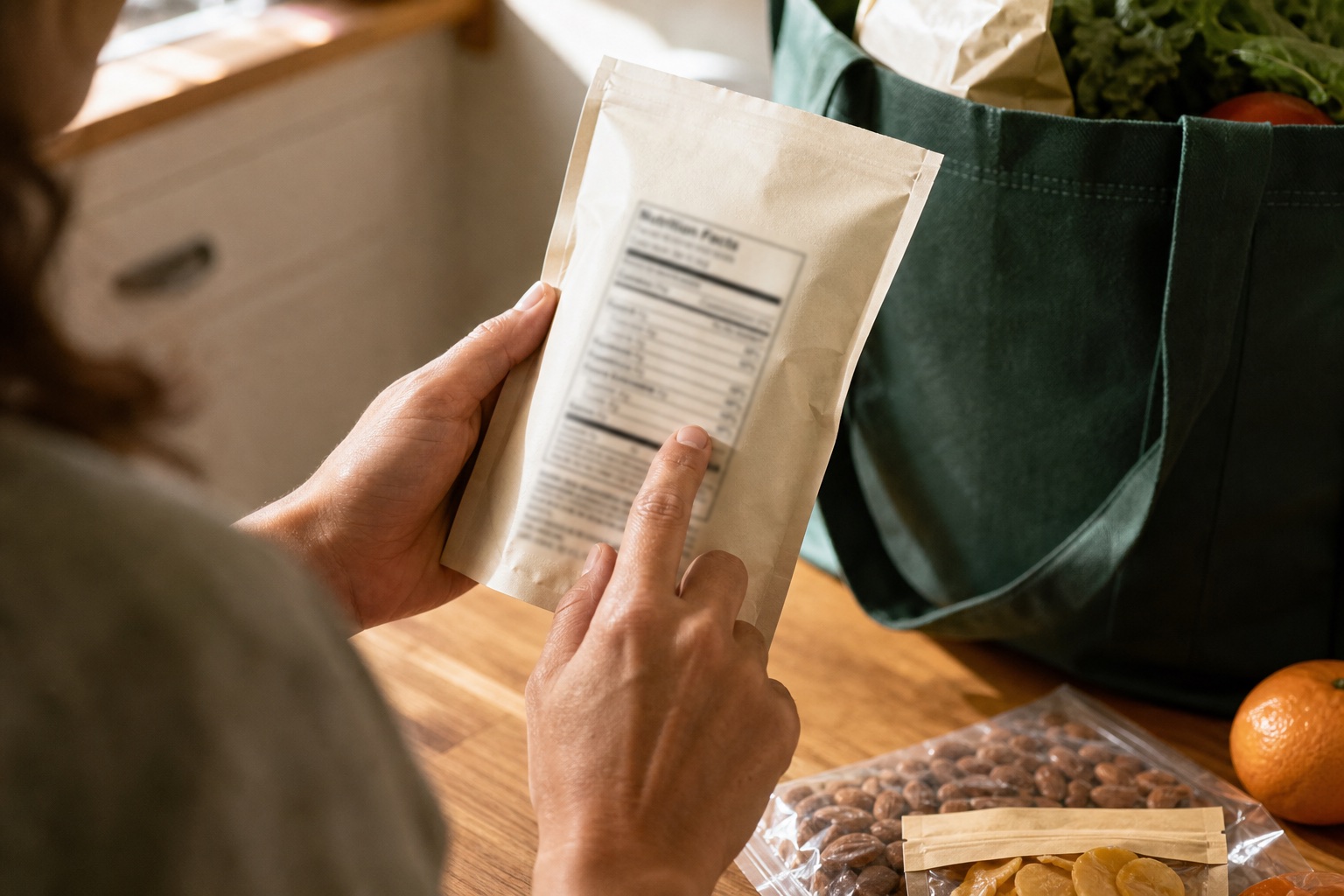
Plain freeze-dried fruit can contain zero grams of added sugar and still show a meaningful number next to Total Sugars. That is not a contradiction. Fruit naturally contains sugar; removing water does not make that sugar “added.” Some products do add sweeteners, coatings, or sweetened fruit preparations, so the format alone is not enough to know.
The direct answer
Freeze-dried fruit does not require added sugar. A product can be made from one ingredient: fruit. But manufacturers can also add cane sugar, syrups, juice concentrates used as sweeteners, or sweetened coatings. Check the package every time.
Read the Added Sugars line, then confirm with the ingredient list. One gives you the amount per serving; the other tells you the source.
Total sugar and added sugar are not synonyms
On the U.S. Nutrition Facts label, Total Sugars includes sugars naturally present in food plus any sugars added during processing. Added Sugars is a subset of Total Sugars. The FDA requires grams and % Daily Value for Added Sugars; it does not set a Daily Value for Total Sugars.
Imagine a one-ingredient strawberry product with this simplified panel:
- Total Sugars: 8g
- Includes 0g Added Sugars
- Ingredients: strawberries
The 8 grams came from the strawberries. Nothing on that label implies table sugar or syrup was added.
Now imagine another product:
- Total Sugars: 13g
- Includes 5g Added Sugars
- Ingredients: strawberries, cane sugar
Here, part of the total is naturally occurring and part was added. These numbers are illustrative, not copied from a brand.
The 20-second package check
- Find the serving size. Every sugar number refers to that amount, not automatically to the whole bag.
- Read “Includes Xg Added Sugars.” Zero means no added sugar is reported for that serving under FDA labeling rules.
- Scan the ingredient list. Ingredients are listed in descending order by weight. Look for sweeteners and sweetened coatings.
- Check whether the bag contains multiple servings. If you eat two servings, you consume twice the labeled added sugar.
Use the FDA’s general %DV guide for context: 5% Daily Value or less is considered low; 20% or more is high. That does not turn the middle into a forbidden zone—it simply places one serving within the day.
Sweetener names worth recognizing
Added sugars can appear under many names, including sugar, cane sugar, brown sugar, dextrose, glucose, fructose, corn syrup, maple syrup, honey, agave, and certain concentrated fruit or vegetable juices used to sweeten foods. The FDA’s definition focuses on how the ingredient is used, not whether its name sounds familiar or “natural.”
A fruit ingredient can also be more complex than it first appears. “Sweetened cranberries,” a fruit preparation, or a coating may bring sugar with it. Read any parenthetical sub-ingredients when provided.
Do not assume that every juice concentrate counts as added sugar in every context. FDA rules contain distinctions based on product type and use. As a shopper, the Added Sugars line is the clearest practical answer for the packaged product.
“No added sugar” is not “sugar-free”
No added sugar generally means no sugar or sugar-containing ingredient was added during processing for its sugar contribution, subject to FDA conditions. The food may still contain naturally occurring sugar.
Sugar-free is a different regulated claim. It addresses the amount of sugar per labeled serving and has its own conditions. A bag of plain fruit is not likely to be sugar-free simply because it has no added sugar.
Unsweetened may be useful plain-language context, but never let a front-of-pack phrase replace the panel. And “natural” does not answer the added-sugar question.
Three common label patterns
1. Fruit only
The ingredient list names only fruit, and Added Sugars is 0g. This is the clearest one-ingredient pattern.
2. Fruit plus a functional ingredient
The list may include fruit plus oil, an anti-caking ingredient, citric acid, or another processing aid. This is not automatically a sweetened product; check the Added Sugars line.
3. Fruit plus sweetener or coating
The list includes sugar, syrup, a sweetened preparation, chocolate, or a yogurt-style coating, and the panel may report added sugar. Evaluate it as the composed snack it is, not as plain fruit.
A sweet-tasting fruit is not proof of added sugar. A fruit-shaped package is not proof of none.
Want the full package scan? Continue with How to Read a Snack Label in 60 Seconds. To understand why the same fruit can look so different by format, see Freeze-Dried vs. Dried Fruit.