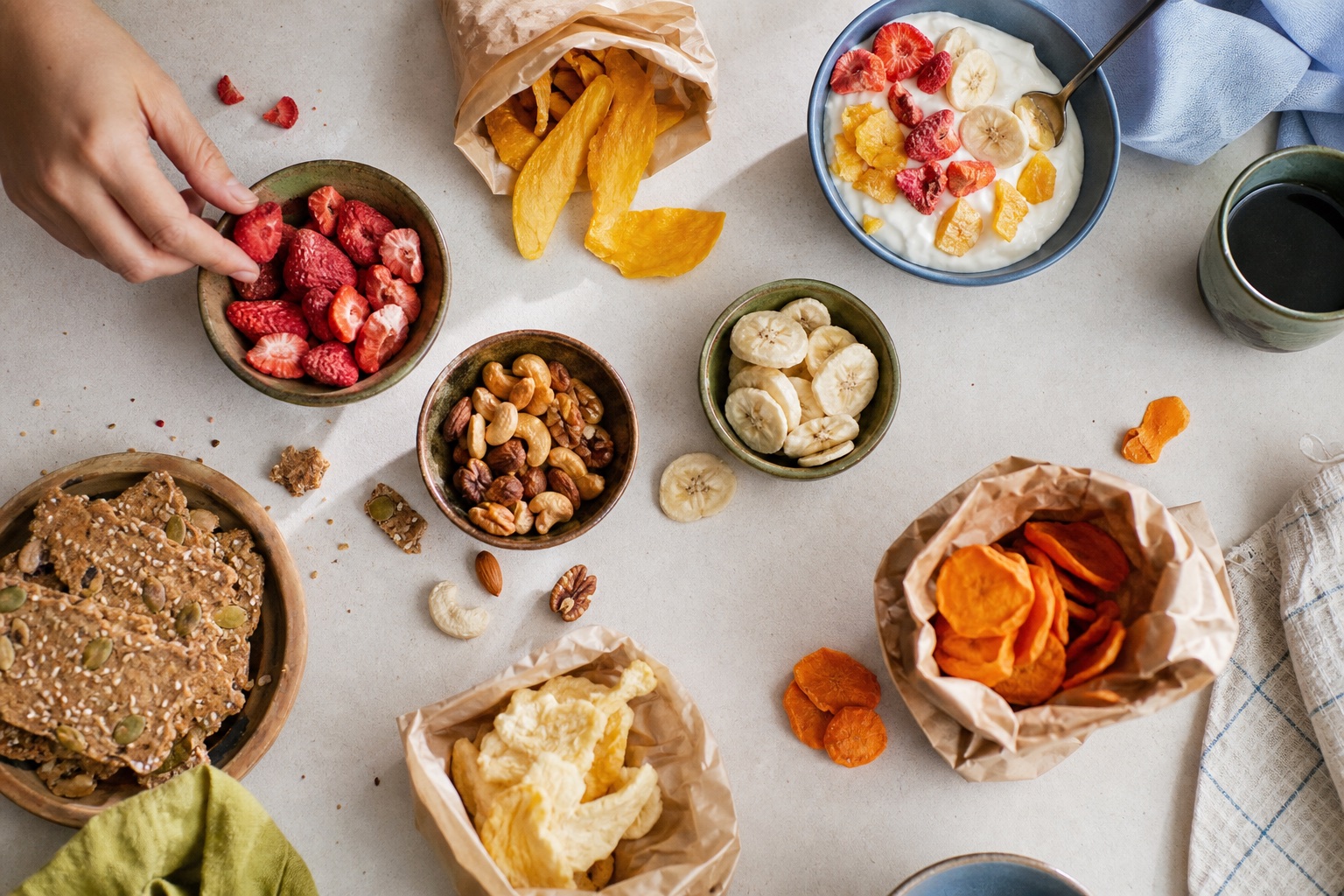
Freeze-dried fruit is often expensive because it combines a high-moisture agricultural ingredient with a slow, equipment-intensive process and protective packaging. The final pouch weighs little precisely because much of the incoming fruit's weight left as water. Labor, equipment time, energy, quality control, breakage, packaging, freight, retailer margins, and unsold inventory still have to be covered.
No public formula explains every shelf price. Fruit type, harvest conditions, plant scale, geography, cut specification, package size, channel, and brand positioning can change the economics. The useful goal is to understand the cost stack—not to assume every premium is automatically justified.
First, you are no longer buying most of the water
Fresh fruit contains substantial water. Freeze-drying removes much of it while trying to preserve the fruit's porous structure. A small finished weight can therefore begin with a much larger weight of fresh material.
This is why comparing a one-ounce pouch with one ounce of fresh fruit creates the wrong mental picture. The two ounces do not represent the same amount of starting fruit, hydration, volume, or eating experience. The dried pouch also concentrates the fruit's naturally occurring sugars and calories by weight because the water is no longer present.
That does not make freeze-dried fruit automatically better value. It explains why the number printed beside “net weight” is unusually small. Fresh, frozen, conventionally dried, and freeze-dried fruit solve different storage and usage problems; our fresh-versus-freeze-dried comparison separates those tradeoffs.
Freeze-drying is a slow vacuum process
The broad sequence includes preparing and freezing the fruit, reducing pressure, supplying controlled heat so ice sublimes directly into vapor, capturing that vapor, and continuing a secondary drying stage to reduce more tightly bound water. The equipment must manage low temperatures, vacuum, heat transfer, and condensation while protecting the product from collapse or scorching.
Research on fruit freeze-drying consistently describes long drying times and significant energy demand as commercial constraints. A study of an orange snack, for example, examined how pressure and temperature changed both processing time and energy consumption. Faster is not automatically better: conditions can also change structure, color, flavor, and the drying endpoint.
Throughput matters as much as the electricity bill. A chamber occupied by one batch cannot dry the next batch. Equipment purchase, maintenance, refrigeration, vacuum systems, cleaning, downtime, facility space, and trained operators all contribute to cost per usable pound.
A product can be physically light and operationally heavy. Long equipment time is part of what the price has to recover.
Not every incoming piece becomes a sellable whole piece
Fruit has to be received, inspected, washed or otherwise prepared, trimmed, cut, loaded, dried, unloaded, and packed. Seeds, stems, peel, bruised areas, size variation, and off-spec material affect usable yield. Agricultural prices and quality also vary by crop and season.
Then comes breakage. Freeze-dried fruit is deliberately porous and crisp, which also makes it fragile. Pieces can fracture during unloading, conveying, filling, shipping, and shelf handling. Powder may still have value as an ingredient, but it may not earn the same price as attractive snack-size pieces.
Whole berries, neat slices, uniform cubes, and mixed bags can each create different tradeoffs between appearance, drying consistency, bite, throughput, and damage. The mechanics become even more complicated when several fruits share one pouch; see Why Mixed Fruit Bags Are Hard to Get Right.
The pouch is part of the product
A conventional paper bag would not adequately protect a food that readily absorbs moisture. Commercial packaging must provide an appropriate moisture barrier, form reliable seals, survive distribution, carry required labeling, and often include a closure that works after opening.
Some products also use oxygen- or moisture-control packets, protective headspace, smaller pack sizes, or more robust shipping cartons. Those choices add cost, but under-packaging can turn crisp fruit into soft fruit before the customer finishes it. Our after-opening guide shows why the barrier continues working after the sale.
Our fruit-pouch guide explains which packaging features shoppers can inspect and which claims require measured evidence.
Freight is not free simply because the product is light. A fragile, voluminous product can fill a case before that case reaches a high weight. Warehousing, pick-and-pack labor, retail distribution, marketplace fees, promotions, returns, and retailer margin then sit on top of manufacturing cost.
How should a shopper compare value?
- Compare like with like. Use price per ounce to compare similar freeze-dried formats, not to declare fresh and dried fruit interchangeable.
- Read the ingredient list. Fruit-only products and sweetened or blended products are not the same proposition.
- Look at usable form. Whole snack pieces, tiny fragments, and powder may be equally edible but valuable for different jobs.
- Consider how much you finish. A larger bag is not a bargain if repeated opening makes it soft before you use it.
- Check the package. An intact barrier and usable closure protect the value you already paid for.
- Compare the job. Portability, long pantry life, low weight, intense crunch, and reduced food waste may matter in one situation and not another.
A high price can reflect real processing constraints, inefficient scale, premium sourcing, retail positioning—or some combination. Category knowledge helps you ask better questions; it cannot audit a company's private books from the shelf. If the shelf still leaves you wondering what is actually a fair comparison, use our freeze-dried fruit price-comparison guide.
Freeze-dried fruit costs more than its final weight suggests because the missing water is part of the production story, not missing value on a scale.
Before buying, use our label-reading guide. To compare the process and texture with conventional dried fruit, read Freeze-Dried vs. Dried Fruit.