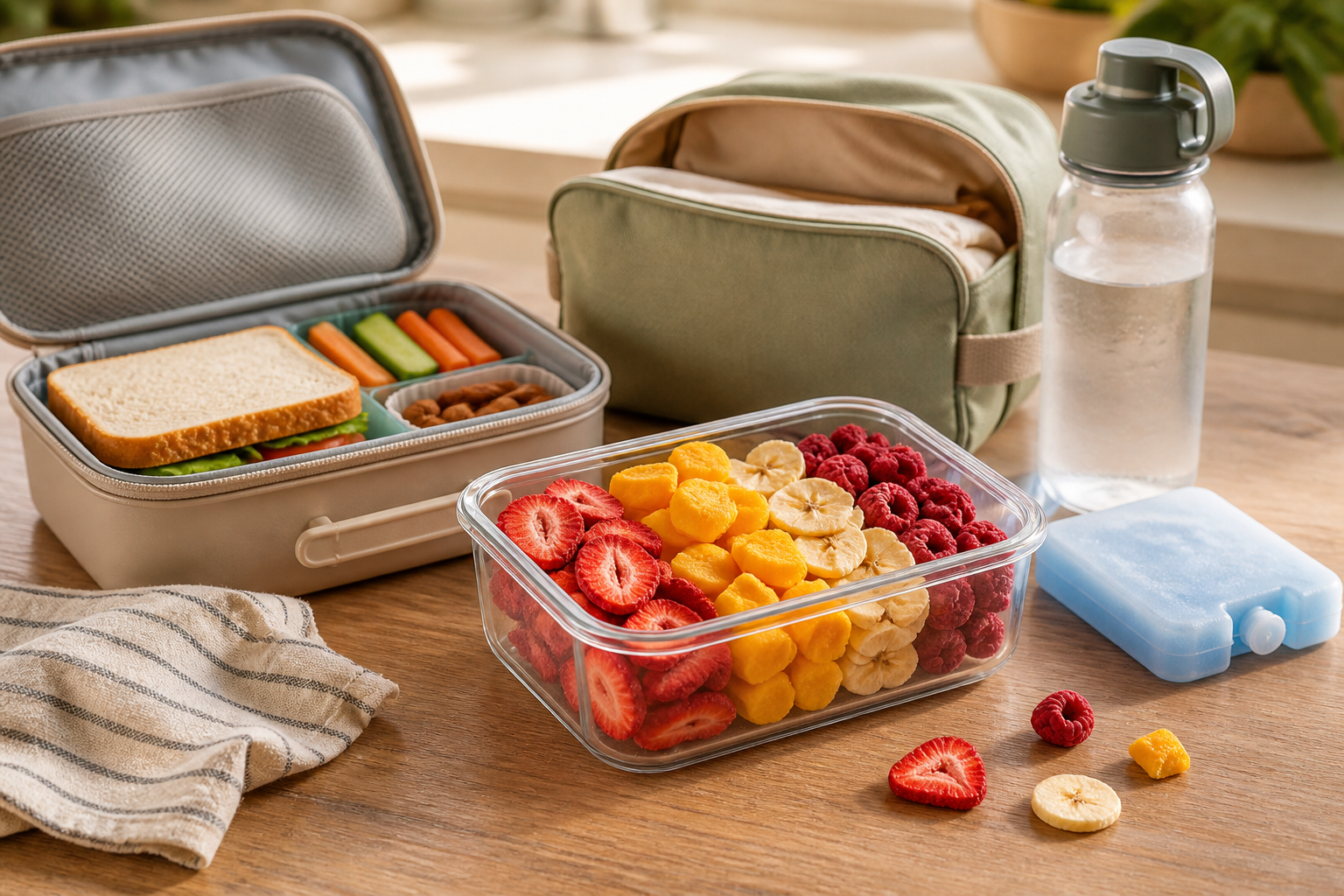
Freeze-dried fruit is one of the easier fruit formats to carry because it is light, shelf-stable when kept dry, and treated as a solid food for U.S. airport screening. The catch is that its crisp texture is fragile. Pack it in a well-sealed dry pouch or small rigid container, keep it away from moisture, and do not confuse the fruit's texture needs with the food-safety needs of yogurt, cheese, sandwiches, or other perishable lunchbox items.
That distinction matters. USDA says freeze-dried food can be shelf-stable when moisture-proof, hermetically sealed packaging protects it. FDA's water-activity guidance and recent freeze-dried-fruit reviews help explain the rest: once the package is open, the fruit's porous structure pulls in moisture easily, so the practical packing job is to control humidity and breakage rather than chase an imaginary universal countdown.
What the fruit actually needs: dryness, closure, and crush protection
USDA's freeze-drying guidance ties shelf stability to the package as much as the process. FDA's water-activity guidance explains why that matters: dry foods move toward equilibrium with the surrounding moisture, and that shift changes texture and stability. A 2024 review in Trends in Food Science & Technology describes freeze-dried fruit as porous and texture-sensitive to final water content.
In plain English, freeze-dried fruit packs well when you treat it like a crisp, brittle dry food, not like a rugged trail mix. The useful hierarchy is simple:
- Best: the original sealed pouch, if it still closes cleanly.
- Next best: a clean, fully dry, small airtight container that limits empty humid headspace and protects fragile pieces from being crushed.
- Least protective: a loose bag used only to corral pieces for a short outing.
If you are packing pieces and powder together, remember that powder is usually the more humidity-sensitive format. TSA also treats powdery substances over 12 ounces as a screening category that may need a separate bin, which is another reason pieces are usually the easier travel format. Our powder-versus-pieces guide covers the format tradeoffs in more detail.
Lunchboxes, work bags, and day trips: the fruit can stay shelf-stable while the meal still needs cold packs
FoodSafety.gov's back-to-school lunch guidance recommends keeping perishable foods at 40 F or below and using at least two cold sources, such as frozen gel packs or frozen drinks, in an insulated lunch bag. That is a whole-meal rule. It does not mean freeze-dried fruit itself must be refrigerated when it is a dry, shelf-stable product.
The better packing move is to separate the issues:
- For the fruit: keep it dry, sealed, and protected from crushing.
- For the rest of the lunch: use insulated storage and cold sources when the meal includes perishable foods.
If the fruit shares a lunch bag with an ice pack, keep it inside its own dry container or intact pouch so exterior condensation does not become interior moisture. That moisture-control step is an editorial inference from the water-activity evidence above, not a special safety rule unique to freeze-dried fruit. The same logic applies on car trips: a hot vehicle mainly threatens the quality and safety of the perishable foods around the fruit, while humidity and rough handling threaten the fruit's crunch.
Portion size matters too. Packing one day's amount reduces repeated openings and keeps the rest of the bag at home in better condition. If your real problem is keeping an opened bag crisp between outings, use our after-opening guide and storage guide.
Air travel: easy for whole pieces, slightly fussier for powder
TSA says solid food items can be carried in either carry-on bags or checked bags, and its item-specific pages list dried fruits as allowed in both. That makes freeze-dried fruit pieces a straightforward airport snack compared with yogurt cups, nut butters, or other foods that slide into liquid or gel rules.
Two practical caveats still matter:
- Powder can draw extra attention. TSA says powders larger than 12 ounces in carry-ons may require separate screening.
- A crushed bag is still a bad snack. Seat-back pockets, overstuffed backpacks, and hard-shell luggage can turn airy fruit into crumbs if the package has no structural protection.
For most travelers, a small sealed pouch or a compact rigid container is the calmest setup. It reduces spills, avoids liquid-rule confusion, and makes it easier to take the fruit out quickly if an officer wants a closer look. If the trip also involves hydration or a more filling snack, pair the fruit with water and a sturdier companion food rather than asking a dry fruit snack to do everything on its own.
International trips and border crossings: declare first, assume less
USDA APHIS says travelers must declare all agricultural products, and fruits and vegetables can be prohibited or require inspection depending on the item and origin. APHIS also maintains a separate list of generally authorized non-propagative plant products that includes many dried, cooked, cured, or otherwise processed fruits and vegetables.
The practical takeaway is narrower than a blanket yes-or-no rule: processed dried fruit is often easier to carry across borders than fresh produce, but you should still declare it and expect country- and commodity-specific rules. Do not assume that a snack which is easy to carry on a domestic U.S. flight will automatically clear a customs inspection on the way home or into another country.
This is one of the main evidence limitations for the topic. Travel rules are procedural rather than nutritional, and they can change by route and destination. The safest advice is procedural too: keep the original label when possible, declare the food, and check the current destination rules before you travel.
What this means for you
The strongest evidence here combines official travel rules, lunchbox food-safety guidance, and dry-food moisture science. There is much less direct research on the single question “What is the best home packing method for freeze-dried fruit in a lunchbox?” The checklist below is therefore a practical synthesis, not a lab-certified universal formula.
- Pack one outing's worth. Smaller portions reduce repeat exposure to humid air.
- Use the original pouch or a dry airtight container. Choose structure as well as closure if the bag will be tossed around.
- Keep the fruit separate from wet or sweating items. Ice packs help the sandwich, yogurt, or cheese; they do not improve the fruit.
- For U.S. flights, pieces are simpler than powder. Solid food is straightforward, while large powders may need extra screening.
- For international travel, declare it. Processed fruit may be easier than fresh fruit, but customs rules still control.
Pack it like a crisp dry food, not like a produce substitute.
If you want the broader category basics first, start with Freeze-Dried Fruit, Decoded. If your main question is whether the open bag still has usable life after the trip, go next to Can Freeze-Dried Fruit Go Bad?.
Primary references
- USDA Ask USDA: Does freeze-drying make food shelf stable?
- U.S. FDA: Water Activity (aw) in Foods
- FoodSafety.gov: Back-to-School Meal Prep: Easy as 1, 2, 3, 4!
- TSA: Food
- TSA: Dried Fruits
- TSA: Powdery Substances
- USDA APHIS: Fruits and Vegetables
- USDA APHIS: Generally Authorized Non-Propagative Plant Products
- Feng S, Bi J, Laaksonen T, Lauren P, Yi J. Texture of Freeze-Dried Intact and Restructured Fruits: Formation Mechanisms and Control Technologies. Trends in Food Science & Technology. 2024;143:104267.