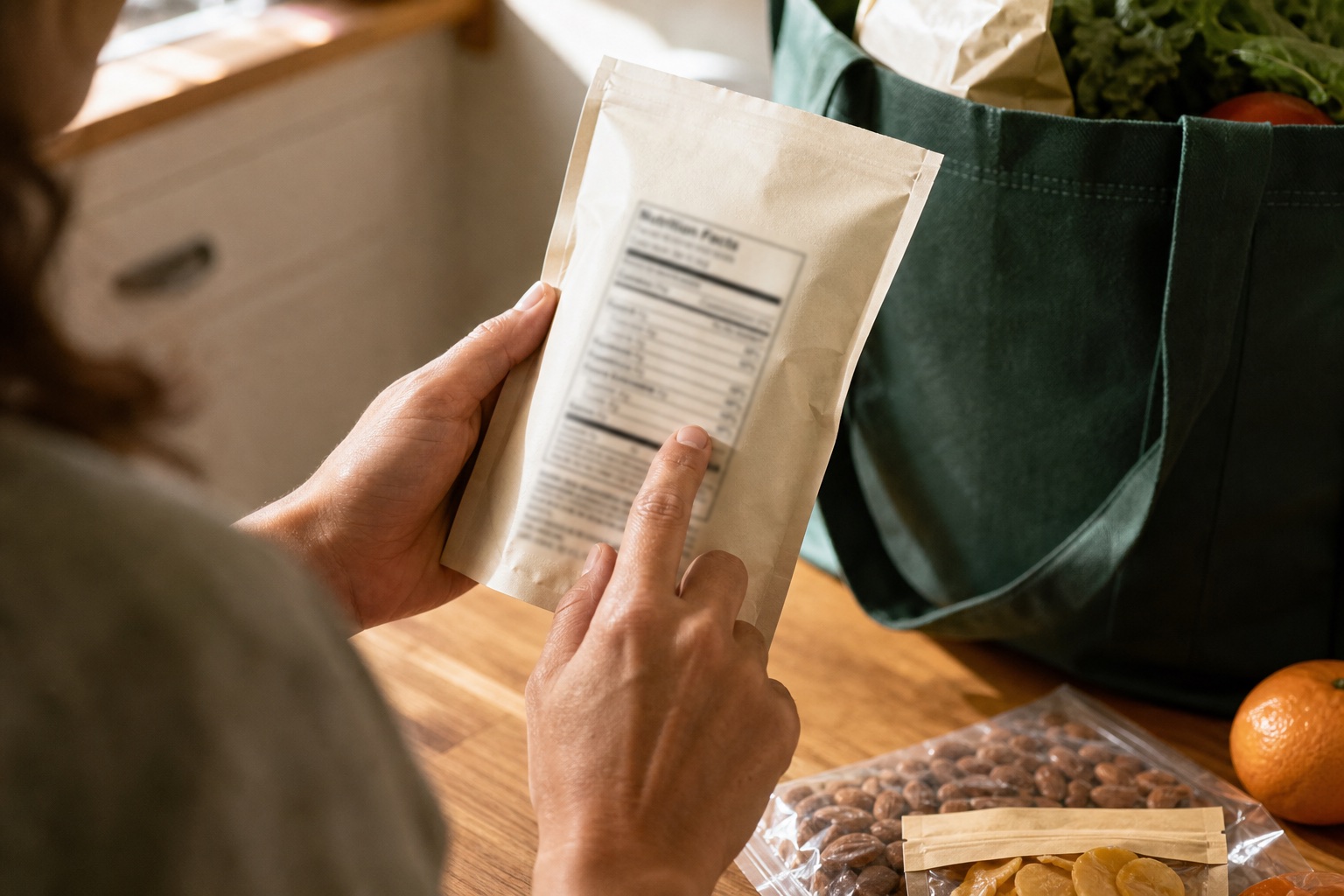
A freeze-dried fruit pouch has to keep the fruit dry, remain sealed through handling, and protect the pieces well enough to reach you in usable condition. Oxygen and light protection can also matter for quality. After opening, the closure and your storage routine become part of the job.
For shoppers, the practical test is an intact package, clear storage directions, and a size that matches how quickly you use it. A metallic finish, resealable zipper, or small packet inside is not proof of a particular shelf life. Start with our freeze-dried fruit field guide if the process itself is new to you.
1. Keep water vapor out—not just spills
Fruit does not need to get splashed to pick up water. University of Minnesota Extension explains that freeze-dried foods readily absorb moisture, including humidity in a kitchen. Its packaging guidance also cautions that some ordinary vacuum-sealer bags allow air and moisture through. Removing air and blocking future moisture are different tasks.
FDA's water-activity guidance explains the underlying principle: food exchanges moisture with surrounding air until they reach equilibrium. Water activity describes water's availability, rather than simply how many grams of water a food contains. Drying establishes a condition that storage must maintain.
Packaging laboratories measure water vapor transmission rate, or WVTR: how much water vapor passes through an area of material over time under specified conditions. ASTM F1249-25 describes a test for flexible barrier materials. Lower transmission means less moisture passing through in a comparable test; it does not automatically translate into a number of days before your strawberries soften.
That distinction changes the buying question. Instead of asking whether a bag feels thick, ask whether the package was selected and tested for this food and its stated storage conditions. For the everyday routine, see how to store freeze-dried fruit.
2. Manage oxygen separately from moisture
An oxygen absorber removes oxygen; a desiccant absorbs moisture. They are not interchangeable. Utah State University Extension's packaging guidance describes oxygen absorbers as a way to reduce oxygen and limit off-flavors. Minnesota Extension distinguishes moisture absorbers from oxygen absorbers in its freeze-dried-food guidance.
The relevant film measurement for oxygen is oxygen transmission rate, or OTR. ASTM D3985-24 describes how it is measured and explicitly cautions that this measurement alone does not determine packaging protection. A good oxygen barrier is not evidence of an equally good moisture barrier.
The barrier limits what enters. An absorber manages its target inside. The closure keeps an opening from defeating the package. None proves that the other two are working.
Do not rank snacks by whether you find a packet inside. The producer may use another packaging approach, and you cannot determine whether an absorber is correctly specified from its presence alone. Follow packet warnings; do not open or eat the contents or substitute household packets into food.
3. Protect the whole package—and the pieces
Material performance describes only part of a pouch. A puncture or open seam creates a separate route into it. On a pouch with a sealed strip above the zipper, that initial seal and the reusable closure serve different stages of use. Pressing the zipper shut after opening does not recreate the original sealed package.
Check the edges and base before buying. After opening, keep crumbs out of the zipper and close its full width. These are practical inspection steps, not a home leak test or a guarantee of safety. If a new pouch arrives open or punctured, set it aside and contact the seller with the lot details.
Physical protection deserves its own check. A flexible pouch can contain fragments without keeping every berry whole. For a crowded backpack, a dry rigid outer container is a reasonable way to protect pieces from direct pressure; this is a handling suggestion, not a tested ranking of containers. Our travel-and-lunchbox guide covers the rest of the packing routine.
4. Make claims shoppers can actually interpret
Shiny, paper-look, clear, and thick describe appearance, not a complete barrier specification. USU describes how layers in foil-laminate packaging perform different jobs. You cannot identify all those layers or their performance by looking at the outside. A window is another material area to account for, not enough information to pronounce the whole pouch good or bad.
If a supplier offers transmission numbers, ask for the test method, units, temperature, and humidity conditions. Compare like with like. Then ask whether the evidence covers material samples or the finished, filled package over its intended storage period. ASTM's public method descriptions explain film testing; they do not certify any snack brand.
For ordinary shopping, you should not need a laboratory report. Clear storage instructions and a usable closure are more actionable than unexplained technical language. If a brand makes an unusually long shelf-life claim, it should explain what product, unopened package, and storage conditions that claim covers. Do not apply it to a bag you have already opened.
What this means for you
The National Center for Home Food Preservation recommends dry, well-closed containers, portions suited to use, and cool, dry, dark storage for dried foods. Repeated opening exposes food to more air and moisture. Applying those principles to a shopping decision gives you this checklist:
- Before buying: check for punctures, separated seams, and an unexpectedly open seal. Read the product's storage directions.
- For one sitting: a small pouch may need no reusable zipper if you finish it immediately.
- For repeated snacking: choose a closure you can use reliably and an amount you will finish. Several small packs can reduce repeated exposure, but may cost more and create more packaging waste.
- If a zipper stops working: move otherwise uncompromised fruit into a clean, fully dry food container with a tight lid. Keep the label and lot information.
- If texture changes: do not use crunch as a safety test. Unexpected dampness or mold calls for a different decision from ordinary breakage; use our spoilage and discard guide.
For an open bag, our after-opening guide explains why the calendar alone cannot predict quality. For the purchase tradeoff, why freeze-dried fruit costs more puts packaging in context without assuming every premium is justified.
What the evidence can—and cannot—tell us
This guide combines agency guidance, university extension advice, and the public scope and significance sections of packaging test standards. We did not access the paid full standards, test commercial pouches, or find a basis for ranking brands or specifying one universal barrier target. Extension advice for home preservation supports general handling principles; its storage timelines are not validated countdowns for an opened retail snack.
Freeze-drying is not sterilization: Minnesota Extension notes that illness-causing microorganisms can survive it. Good packaging maintains storage conditions; it cannot undo earlier contamination. That is why lost crunch and food safety remain separate questions.
Disclosure: Eat Better Snacks launched with support from OhCrisp, a freeze-dried snack company. This guide uses independent sources and includes no partner product rating or private packaging data. See our disclosures.
Sources and scope
- Amy Johnston, University of Minnesota Extension: Freeze-drying food (reviewed 2025). Packaging, moisture uptake, and preservation limits.
- FDA: Water Activity (aw) in Foods (1984). Foundational moisture-equilibrium guidance, not a snack shelf-life study.
- ASTM F1249-25 (2025). Public description of water-vapor transmission testing.
- ASTM D3985-24 (2024). Public description of oxygen transmission testing and its limits.
- Utah State University Extension: Packaging Foods. General packaging and oxygen-control guidance, not a fruit-pouch comparison.
- National Center for Home Food Preservation: Packaging and Storing Dried Foods. Home-dried-food storage principles; its drying and conditioning instructions are outside this guide's scope.