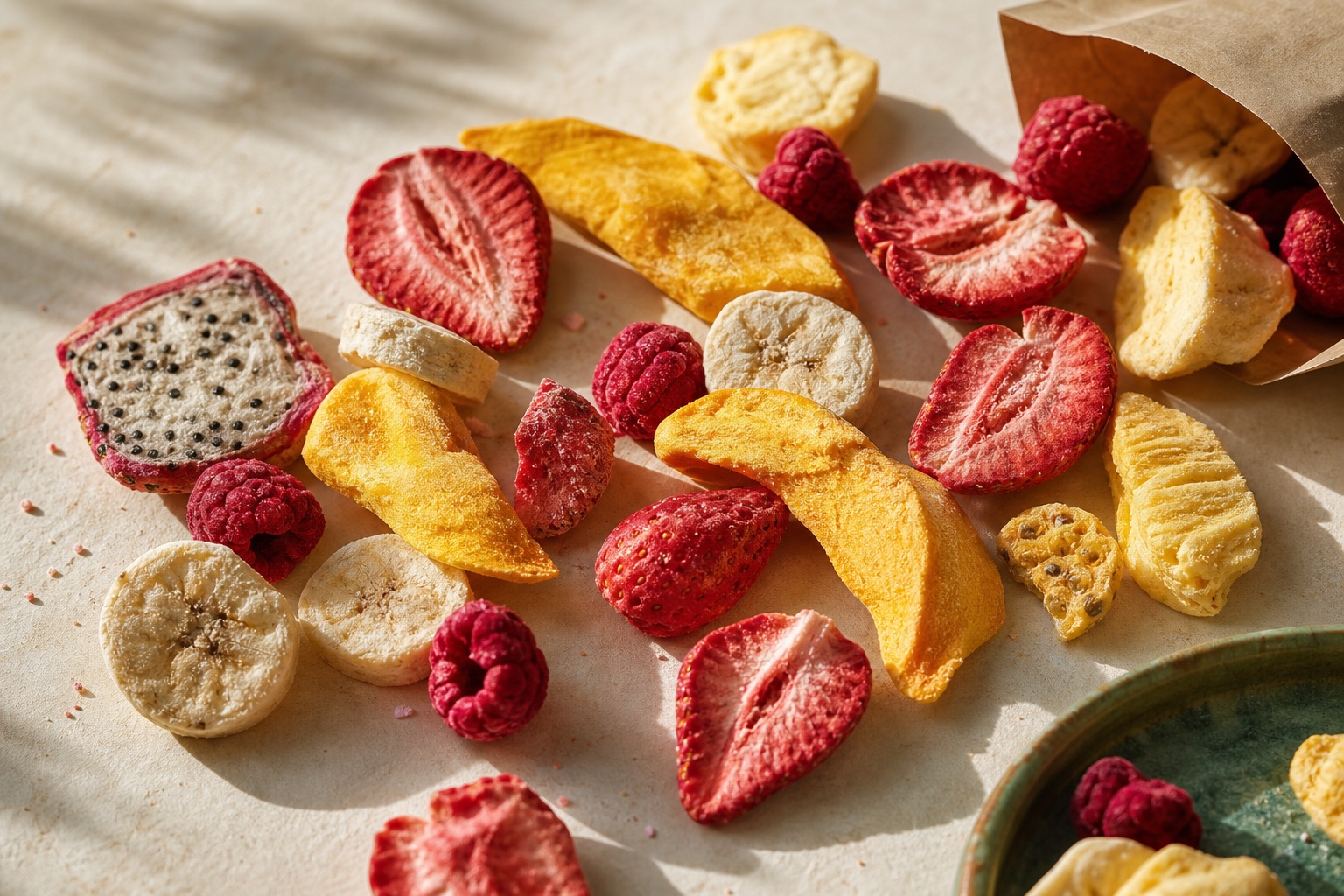
Many dry, crisp foods soften when they take up water from their surroundings. In freeze-dried fruit, that water changes a brittle structure so it no longer fractures in the same way. To protect the crunch, portion into a dry dish, close the pack promptly, and keep it away from steam. If adding fruit to yogurt or another moist food, add it at serving time when crunch matters.
The deeper question is why fruit can lose its snap without looking soaked—and why one piece can become chewy while another stays crisp. The answer involves both moisture and the structure it enters. Our freeze-dried fruit field guide explains the drying process; this guide follows what happens afterward.
Water can arrive through the air
FDA's water-activity guidance describes how food exchanges moisture with the surrounding air toward equilibrium. Water activity, written aw, describes the water's availability; moisture content tells you how much water is present. The two measurements are related, but they are not interchangeable.
At equilibrium, water activity equals the surrounding relative humidity divided by 100, at the same temperature. For example, air at 60% relative humidity corresponds to a water activity of 0.60 at equilibrium. That does not mean a newly opened strawberry instantly reaches 0.60, or that it contains 60% water. Nor is 60% a recommended storage target.
Think of that relationship as the direction of travel, not a stopwatch. It cannot tell you how quickly an open bowl will change. University of Minnesota Extension specifically warns that freeze-dried food readily absorbs moisture, including from kitchen humidity. For the barrier and closure side of this problem, see what a fruit pouch has to do.
A dry structure can become more flexible
A 2024 review by Shuhan Feng and colleagues describes freeze-dried fruit texture through three interacting features: the pores and cells, the solid ingredients, and the remaining water. Removing ice leaves spaces within a structure containing cell-wall materials and sugars.
Scientists call part of the very dry structure glassy: rigid and relatively immobile, not literally made of glass. Added water can help its molecules move more easily. This is called plasticization; it does not mean plastic has been added to the food. Water can lower the temperature at which that structure becomes more rubbery, known as its glass transition. At the same room temperature, the bite can therefore change.
The review also describes cases where a little water initially increases measured hardness before further softening. A harder bite and a crisper bite are not interchangeable. Glass transition is a useful explanation, not a single switch that predicts every fruit's texture.
How much water is present? How available is it? How does this particular structure break? A moisture percentage, water-activity reading, or hard bite cannot answer all three.
What the experiments actually tell us
In a 2011 study in the Journal of Food Engineering, G. Moraga, P. Talens, M. J. Moraga, and N. Martínez-Navarrete examined freeze-dried Granny Smith apple and Cavendish banana slices, cut 5 millimeters thick. They related moisture uptake at 20°C (68°F) to glass transition and mechanical and optical changes. Their conclusion was that both water activity and glass transition help interpret mechanical behavior; the two fruits also differed in moisture uptake.
This is evidence about particular prepared slices under controlled conditions. It cannot establish how many minutes every retail fruit will stay crisp. We reviewed the publisher's methods, results, and conclusion excerpts; the full paper was not available in this review. We therefore do not repeat its numerical thresholds as household rules.
A newer 2025 experiment by Agata Marzec, Jolanta Kowalska, Marcin Korolczuk, and Hanna Kowalska helps explain why measuring crunch takes more than a moisture reading. They compared one strawberry variety with six pretreatments—sucrose solution or chokeberry concentrate for one, two, or three hours—and an untreated control, all freeze-dried. Their compression-and-sound analysis used 15 replicates.
The chokeberry-treated samples had lower water activity yet lower reported instrumental crunchiness than the sucrose-treated samples. These were different formulations, not the same snack exposed to increasing humidity. The result does not show that adding moisture preserves crunch. It shows why comparing different products solely by water activity can mislead.
We use that study's directional comparison, not its numerical crunchiness index: its methods describe the index as a product, while the tabulated values appear consistent with division. It also lacks a consumer tasting panel. Those limits matter when translating an instrument's output into the bite you enjoy.
What this means for you
Use the water source and the texture you want to choose your next step. The following is our practical application of the evidence, not a tested ranking of containers or serving methods.
- Serving a crisp snack: put out a small portion and close the rest. Refill the dish if needed instead of leaving the whole supply exposed.
- Working beside steam: move the open fruit away from the kettle, pot, or dishwasher before portioning. Closing it sooner is more useful than trying to guess the room's humidity from how it feels.
- Adding a yogurt topping: keep the fruit separate until serving if you want contrast. If you want softened fruit throughout, stir it into the portion you will eat. Treat that as a different texture goal.
- Packing lunch: separate dry fruit from moist ingredients with a closed, dry container. A divided tray with shared airspace is not the same as a moisture barrier.
- Finding a tougher or quieter bite: review the storage history and seal. Do not infer a precise water activity, a defective drying process, or a safety verdict from that observation alone.
The National Center for Home Food Preservation recommends clean, dry containers, portions suited to use, and cool, dry, dark storage for dried foods. It notes that reopening exposes food to air and moisture. These are useful general principles; its home-drying timelines are not an opened retail pouch's expiration date.
Use our storage checklist for the everyday routine and after-opening guide for the timing question. For deliberate softening in cooking, see ways to use freeze-dried fruit.
Crunch cannot establish food safety
Minnesota Extension explains that freeze-drying does not kill all illness-causing microorganisms. A crisp piece can therefore still be contaminated, while a soft bite alone cannot diagnose spoilage. NCHFP advises discarding moldy dried food. Unexpected dampness, condensation, or a compromised package calls for a separate assessment—not a taste test. Our spoilage and discard guide covers that decision.
This article provides no home heating or re-drying procedure. Restoring a preferred texture would not demonstrate that a compromised snack is safe.
How far the evidence goes
The evidence supports moisture management and a product-specific view of texture. It does not supply a universal humidity threshold, an open-bag countdown, or a brand ranking. Feng and colleagues provide a narrative research review, not a pooled estimate from standardized consumer trials. The strawberry study tests processing choices, not home storage. Neither replaces product-specific shelf-life validation.
Disclosure: Eat Better Snacks launched with support from OhCrisp, a freeze-dried snack company. This article uses third-party evidence, with no partner product evaluation or claimed first-hand experiment. See our disclosures.
Sources and reading notes
- Feng, Bi, Laaksonen, Laurén, and Yi (2024), Trends in Food Science & Technology 143, 104267. Texture formation review; accepted manuscript read, including sections 3.1–3.2 and conclusions.
- Moraga and colleagues (2011), Journal of Food Engineering 106, 212–219. Apple and banana study; publisher excerpts only.
- Marzec and colleagues (2025), Applied Sciences 15, 11704. Full paper reviewed. Authors report no external funding or potential conflicts; data available on request. Index inconsistency limits quantitative interpretation.
- FDA (1984), Water Activity (aw) in Foods. Definitions and equilibrium relationship.
- Amy Johnston, University of Minnesota Extension (reviewed 2025), Preserving food at home: Freeze-drying. Moisture uptake and microbial survival.
- NCHFP, Packaging and Storing Dried Foods. General handling guidance from So Easy to Preserve, sixth edition (2014).